Trocken Means Sweeter
Lees Aging & Dosage
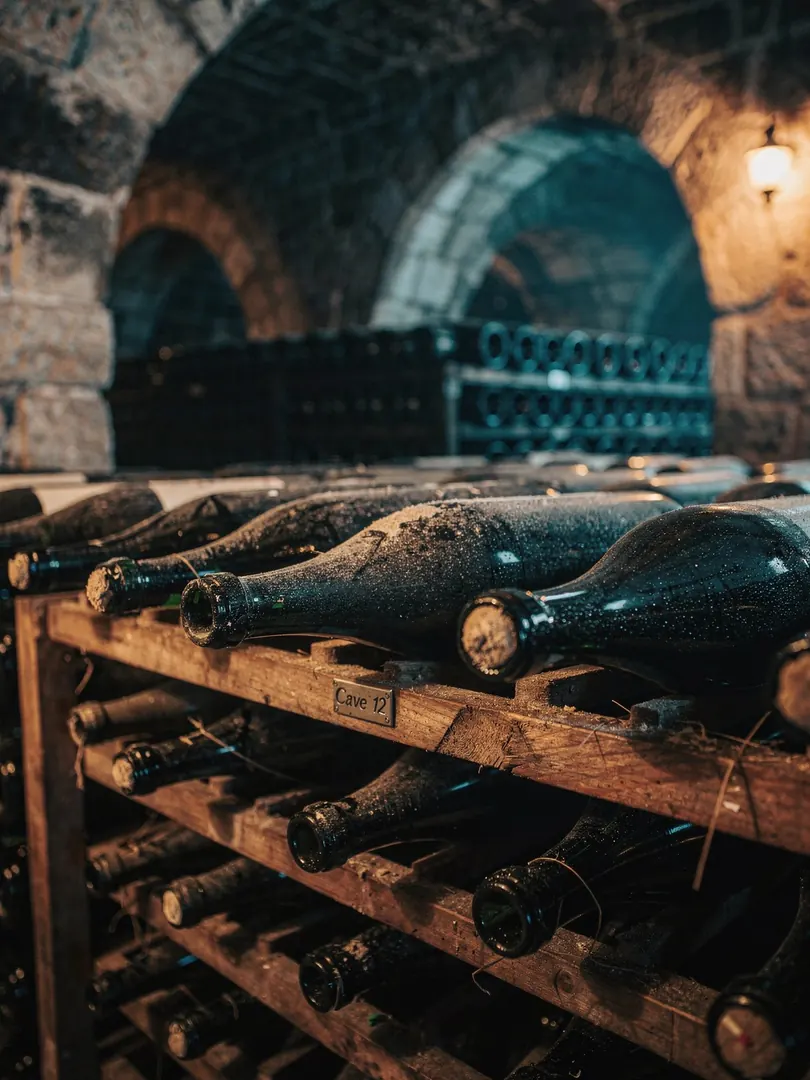
How long must Sekt age on the lees? Under EU law, tank-fermented Sekt needs just 90 days of lees contact within a six-month production period, while bottle-fermented Sekt requires nine months. A winegrower's Sekt from Saale-Unstrut therefore has at least nine months behind it, while a tank-fermented Sekt can reach the market after just half a year.
During aging, the yeast dies off and releases compounds into the wine. This autolysis brings aromas of bread, brioche, and nuts, and rounds out the mousse. The longer the lees contact, the more pronounced these notes become—though generally weaker in tank than in bottle.
In the bottle, the lees first collect as sediment against the glass. During riddling, they gradually move into the neck, and then disgorgement takes place: the bottle is opened, and the pressure pushes the lees out. In tank production, filtration takes over this task, which is why tank-made Sekt is ready faster.
Next comes the dosage, known as the liqueur d'expédition. It determines the sweetness level: Brut Nature has under 3 grams of sugar per liter, Extra Brut 0 to 6, Brut under 12, Extra Dry 12 to 17. Trocken (dry) means 17 to 32 grams, Halbtrocken (off-dry) 32 to 50, and Mild (sweet) over 50. Stating the sugar level is mandatory for Sekt.
So if you spot “Sekt trocken” or “halbtrocken” on the shelf, you're actually buying more sugar than Brut, not less. This is a common mix-up, since “trocken” has entirely different thresholds for still wine. Extra Dry, too, is sweeter than Brut, despite sounding drier.
The dosage may raise the actual alcohol content by no more than 0.5 percent ABV. A Sekt with 12 extra grams of sugar ends up tasting more rounded than sweet, because its acidity balances out the sugar. This holds especially true for Sekt from cool sites like those around Freyburg an der Unstrut and Naumburg.