Tank or Bottle
The Second Fermentation
How does wine from Freyburg an der Unstrut become Sekt? Through a second fermentation, in which yeast and sugar produce carbon dioxide inside a sealed vessel, with nowhere for the gas to escape. That vessel is either a bottle or a pressure tank, and this determines what may later appear on the label.
Large branded Sekts are usually made in tanks. The law requires a minimum production time of six months for this method, including at least 90 days of contact with the lees, or at least 30 days in tanks equipped with stirrers. The process was patented in Italy: Federico Martinotti had it patented in Asti in 1895, and Eugène Charmat improved it in 1907.
In the bottle, production must take at least nine months. The term “bottle fermentation” may also appear on the label even if the Sekt, after fermentation, was transferred under pressure into a tank, filtered, and rebottled. This transfer process is known as the transvasement method and is a generally recognized, permitted technique.
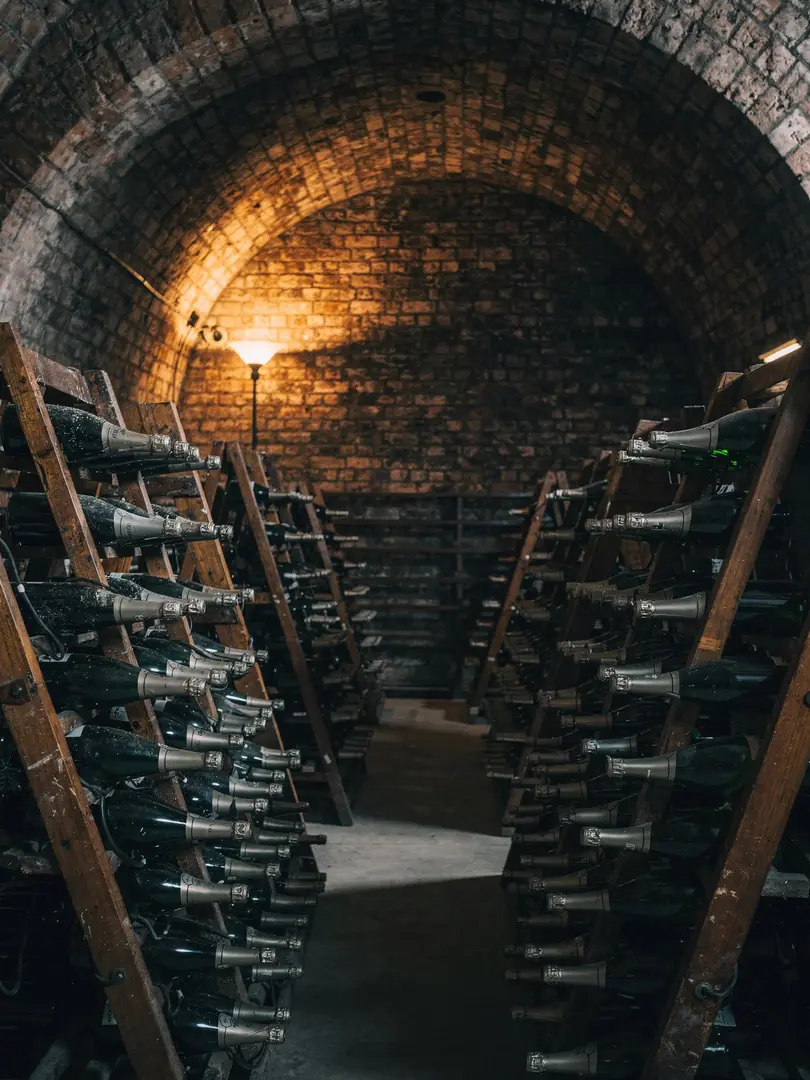
“Traditional bottle fermentation” is different: here the Sekt remains uninterrupted on the lees in the same bottle, at the same producer, for at least nine months, and is disgorged from that very same bottle. A winegrower's Sekt from Saale-Unstrut must be made exactly this way; a branded Sekt doesn't have to be.
During bottling, known as tirage, the dosage is added to the base wine. A finished Sekt must have a minimum pressure of 3.5 bar, and a Sekt b.A. is sold in the classic Sekt bottle with a mushroom-shaped cork, wire cage, and foil.
So it's the label, not the name of the winery, that reveals which method a bottle went through. Placing a branded Sekt like Rotkäppchen next to a winegrower's Sekt therefore means comparing two different approaches, not two quality tiers.
Dry Branded SektTank fermentation · Base wines of various grape varieties and origins
- Time on lees
- 3–6 Months
- Sugar
- 17–32 g/l
- Alcohol
- 11–12 % vol
Fresh and fruity, little yeast character, consistent in style year after year.