Yeast and Sugar
Lees Aging & Dosage
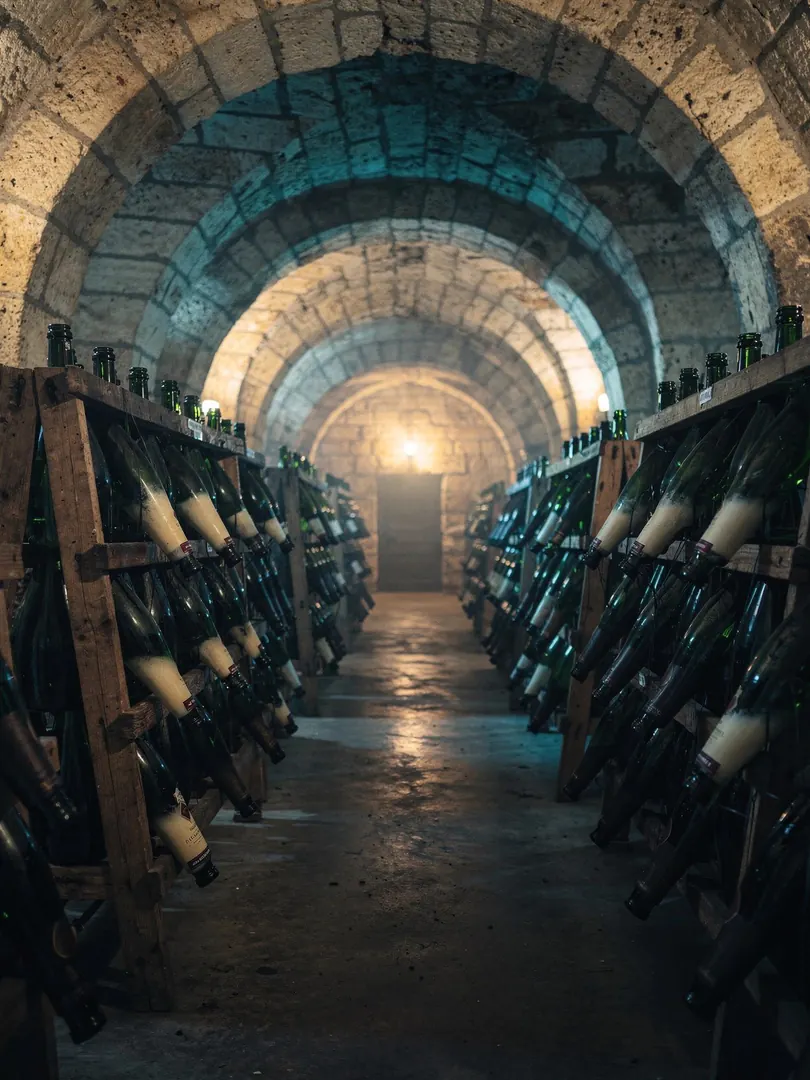
Nine months is the minimum for Sekt labeled 'traditional bottle fermentation.' How long a house actually waits is its own call. Menger-Krug in Deidesheim, according to the house, lets its Sekts rest on the lees for up to 24 months before disgorgement.
On the lees, something called yeast autolysis takes place. The spent yeast cells break down and release compounds into the wine. This produces aromas of bread, brioche, and nuts, and makes the mousse creamier. A Riesling Sekt aged this way loses none of its freshness but gains depth.
Afterward, the lees must be removed. The bottles are riddled until the sediment collects in the neck, then dipped neck-down into a freezing bath to form an ice plug. During disgorgement, the pressure shoots the plug out. What remains is clear Sekt, now missing a small amount of liquid.
That gap is filled by the dosage, a mixture of wine and sugar, which determines the sweetness level. Brut contains under 12 grams of sugar per liter, Extra Dry between 12 and 17, and Dry (trocken) between 17 and 32. Here's a pitfall: on a Pfalz Riesling Sekt label, 'trocken' often indicates a sweetness that many would perceive as off-dry.
A word on 'lieblich' (semi-sweet). This term applies to still wine; for Sekt, the sweetest tier is called 'mild,' with over 50 grams of sugar. The dosage may raise alcohol by no more than 0.5% ABV. Little wonder, then, that Sekt makers handle it with care.