Calories and Sugar
How Many Calories Are in a Glass of Sparkling Wine?
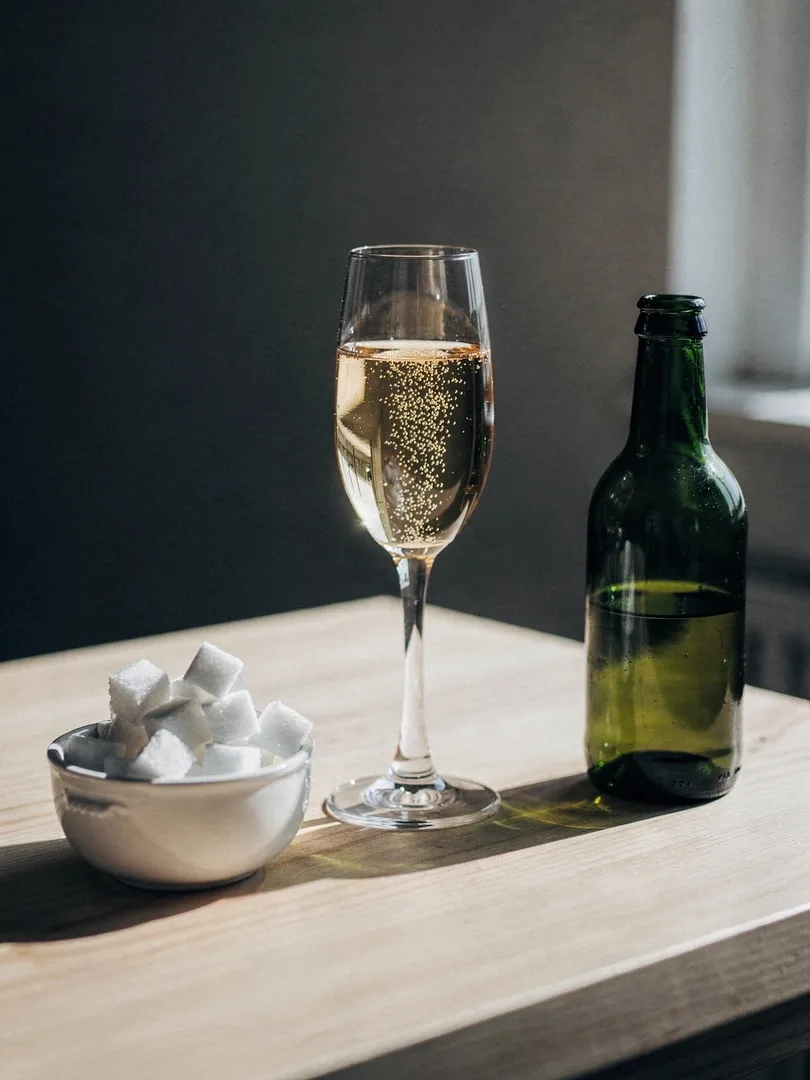
A glass of brut sparkling wine, 0.1 liter at 12% ABV, has roughly 70 kilocalories, almost all from the alcohol. The sugar barely registers for brut, but it does add up noticeably at sweeter levels like demi-sec or doux. Since late 2023, the energy value has been required on the label.
Calories in Sparkling Wine: How It's Calculated
Anyone wanting to know where the calories in sparkling wine come from only needs two figures from EU food law. Regulation (EU) No. 1169/2011 sets out in Annex XIV the factors used to calculate energy value: 7 kilocalories (29 kilojoules) per gram of alcohol and 4 kilocalories (17 kilojoules) per gram of carbohydrates, which includes sugar. Fat and protein are practically absent in sparkling wine and can be left out of the calculation.
A sparkling wine at 12% ABV contains 12 milliliters of pure alcohol per 100 milliliters. Because alcohol is lighter than water, this only weighs about 9.5 grams. Multiplied by seven, that comes to a good 66 kilocalories. A brut may contain less than 12 grams of sugar per liter, so at most about 1.2 grams per glass, which adds less than 5 kilocalories. Altogether, a typical glass of brut sparkling wine comes to around 70 kilocalories.
Does Sugar Make the Difference in Sparkling Wine?
When it comes to calorie content, alcohol matters more than sweetness. Even a demi-sec sparkling wine with 40 grams of sugar per liter only adds around 16 kilocalories from sugar per glass, about a quarter of what the alcohol contributes. A doux sparkling wine with 60 grams of sugar per liter comes to around 24 kilocalories from sugar, and together with the alcohol lands at about 90 kilocalories per glass.
Conversely, a Brut Nature with less than 3 grams of sugar only saves a few kilocalories compared with a regular Brut. Anyone watching their energy intake with sparkling wine gains more from a lower alcohol content than from an even drier sweetness level. An exception is sweet Muscat sparkling wines like Asti: they're low in alcohol but high in natural residual sugar, which largely evens out the energy value again. How the sweetness levels from Brut Nature to doux are precisely defined is explained in the chapter on dosage.
What's Been Required on the Label Since 2023?
For a long time, wine and sparkling wine didn't have to declare nutritional values, unlike nearly all other foods. Regulation (EU) 2021/2117 has changed that. For wine products made from December 8, 2023 onward, the energy value must appear on the label, in kilojoules and kilocalories per 100 milliliters, sometimes shown only with the symbol "E" for energy. Older bottles may still be sold without this information.
Producers may also provide the remaining nutritional values and the list of ingredients digitally, usually via a QR code on the back label. Under EU rules, this code must not lead to advertising or sales, and no reader data may be collected through it. Allergens such as sulfites, however, must still appear directly on the bottle. A standard pour is 0.1 liters (100 ml), while a piccolo holds twice that at 0.2 liters (200 ml).
Calories in Prosecco, Champagne, and Alcohol-Free Sparkling Wine
Because the calculation is the same everywhere, the well-known sparkling wines differ little in calories. Champagne, Crémant, Cava, and Sekt usually sit around 11 to 12.5% ABV. At the Brut level, that works out to roughly 65 to 75 kilocalories per 0.1 liter (100 ml). Prosecco is often also available as Extra Dry or Dry, meaning sweeter than Brut, which adds a few extra kilocalories from sugar. A Prosecco Frizzante with slightly lower alcohol partly offsets this again.
Alcohol-free sparkling wines save the biggest chunk of calories. Their energy content depends almost entirely on sugar, and in some products this is actually higher than in a Brut, since the sweetness is meant to compensate for the missing alcohol in flavor. It's worth checking the kilocalorie figure especially here. For how such wines are made and how they differ from the original, see the chapter on alcohol-free sparkling wine.