Picking Early, Blending
Base Wine & Blend
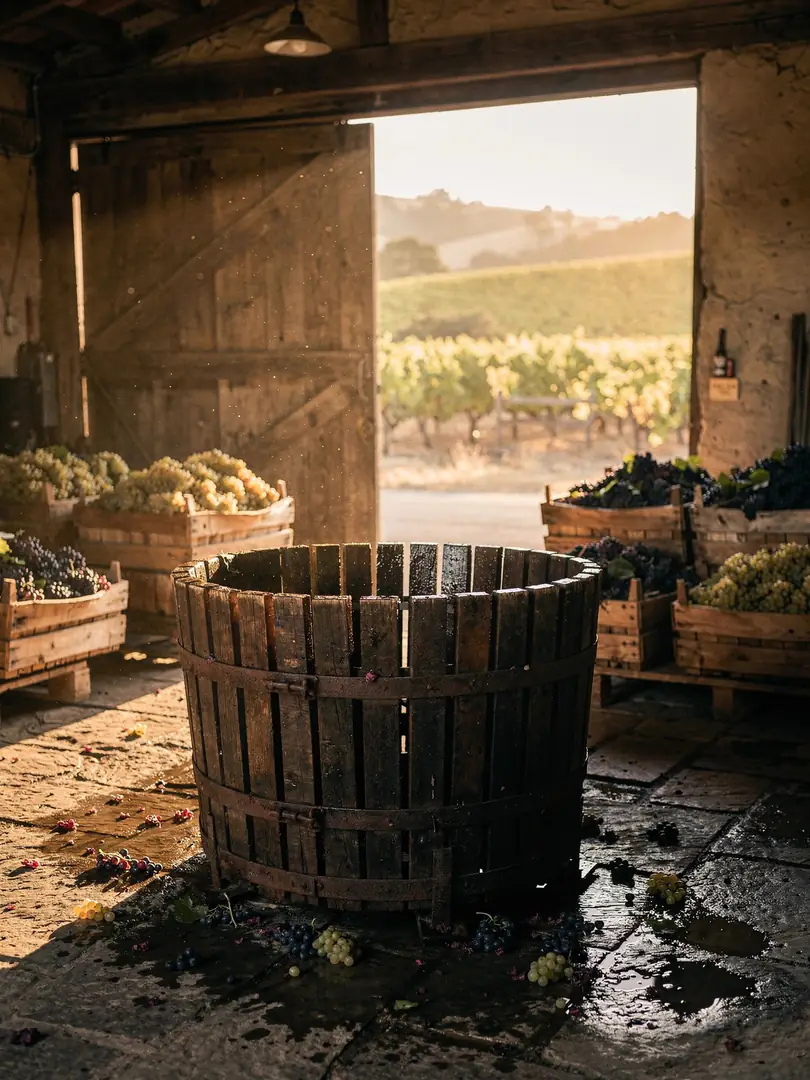
In late summer, while many red wine grapes still need weeks to ripen, the harvest for sparkling wine begins in Los Carneros. Grapes are picked early and by acidity, not sugar level. The base wine should be fresh, lean, and not too alcoholic, since the second fermentation in the bottle will raise the alcohol by roughly one percentage point.
Whole clusters go into the press and are pressed slowly and gently, so that neither color nor tannin from the skins passes into the juice. This applies even to Pinot Noir, a dark-skinned grape that must still yield pale must. Champagne separates two fractions here, the fine cuvée from the first pressing and the coarser taille that follows. From 4,000 kilograms of grapes, that yields 2,050 liters of cuvée and 500 liters of taille.
The first fermentation turns the must into a still base wine, which the French call vin clair. A house working with multiple vineyards and varieties ends up with many individual wines in the cellar, each with its own character. None of them would make a sparkling wine worth pouring on its own.
Then comes the assemblage, the blend. The cellar master tastes every lot and assembles the cuvée meant to taste like the house style year after year. Reserve wines, kept back from older vintages, help with this. A house bottling without a vintage uses them to smooth out the differences between warm and cool years. Domaine Carneros also offers a vintage-dated Brut Cuvée, according to its own information, in which a single year takes center stage.
Blanc de Blancs means white from white grapes, here pure Chardonnay. Blanc de Noirs means white from dark grapes; in Carneros that's Pinot Noir, whose juice stays pale as long as it isn't left on the skins. Both styles show how much the choice of grapes decides before the second fermentation even begins.