Bottle Instead of Tank
The Second Fermentation
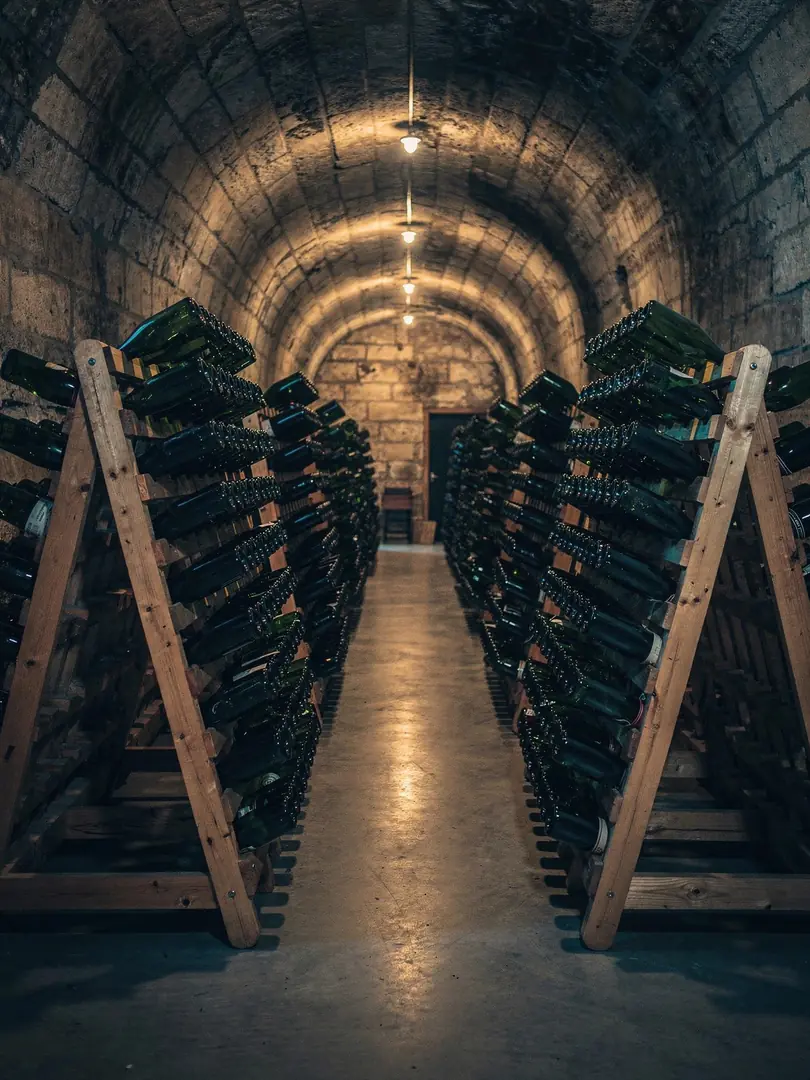
When does a still wine become a sparkling wine? The moment the cellar master performs the tirage. The finished base wine is blended with a solution of sugar and yeast and bottled. The bottles are sealed with a crown cap and then laid down horizontally in the cellar.
Now the yeast converts the sugar into alcohol and carbon dioxide. The gas has nowhere to escape and stays dissolved in the wine. In Champagne, this builds pressure of about 6 bar, several times atmospheric pressure. That's why sparkling wine bottles are so thick-walled and have an indented base.
The houses of Napa and Carneros mostly follow the Champagne model. Domaine Carneros describes its sparkling wines as méthode traditionnelle, and Schramsberg set out from the start to make a sparkling wine in the Champagne style. Mumm Napa and Domaine Chandon belong to Champagne houses that brought their methods to California.
There are two other paths as well. The tank method lets the second fermentation take place in a large pressurized tank, which is faster and cheaper. In the transfer method, the wine ferments in the bottle but is then emptied under pressure into a tank, filtered, and rebottled. The ancestral method, in which the wine is bottled while the first fermentation is still underway, is the exception in Carneros and Napa.
The profile below shows a typical Californian Brut made through bottle fermentation. Aging times and sugar levels vary from house to house, so ranges rather than fixed figures are given.
Californian BrutBottle fermentation · Chardonnay, Pinot Noir, Pinot Meunier
- Time on lees
- 12–36 Months
- Sugar
- 6–12 g/l
- Alcohol
- 12–12.5 % vol
Ripe pear and citrus, brioche, fine mousse, taut acidity.