Canals & Colonists
Region & History
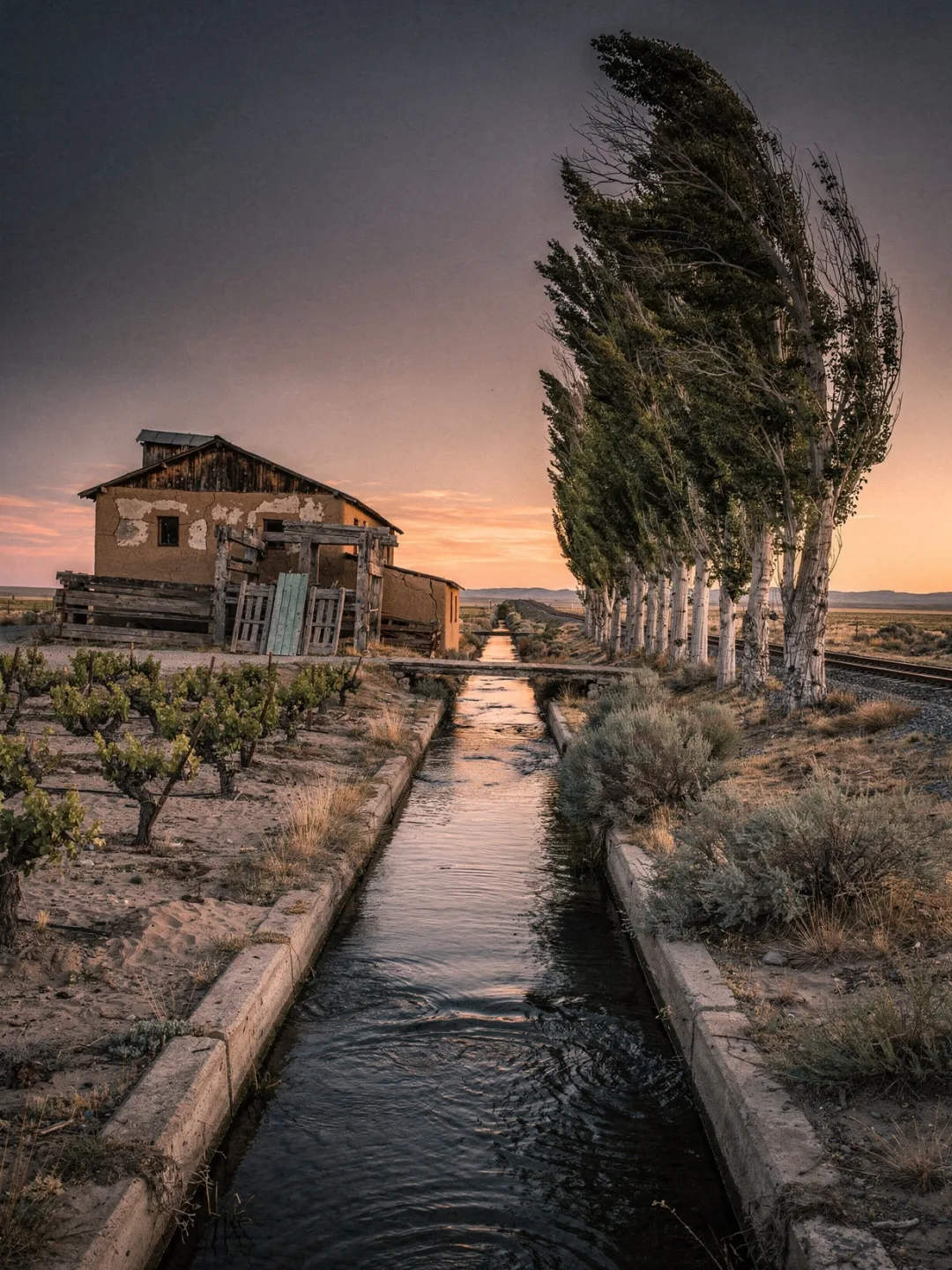
Before vines stood here, the valley at the thirty-ninth parallel was mostly dry. Steppe, thornbush, wind. Right through the middle runs the Río Negro, carrying its water from the Andes to the Atlantic without the surrounding plain getting much benefit from it. That changed only after General Julio A. Roca drove out the peoples living there during the so-called Desert Campaigns starting in 1879, opening the land to the railway and to colonists.
Drawing water from the river became the region's real engineering challenge. The Italian engineer César Cipolletti, working for the government, surveyed the Limay, Neuquén, and Negro rivers for their irrigation potential. The British railway company Ferrocarril del Sud then built the Great Canal. It didn't have to pay for it: it simply billed the materials, much of it imported from England, securing future freight business for itself in the process. Its subsidiary, the Compañía de Tierras del Sud, parceled up the freshly irrigated land. Sales began in 1913, to settlers from Spain, Italy, and England.
Right in the middle of this upheaval came the founding of Humberto Canale. The engineer, who had previously worked in civil service, bought six hundred hectares near General Roca in 1909 and brought in vines from Bordeaux: Cabernet Sauvignon, Merlot, Sémillon, Sauvignon Blanc. The bodega still exists today, now in its fifth generation of the same family, and is both the oldest and largest in the Alto Valle. Even so, wine long remained a side product. What made the valley rich were pears and apples — to this day, the Alto Valle alone supplies most of Argentina's fruit harvest.
The second awakening came ninety years later, this time built around wine from the very start. In 1999, Bodega del Fin del Mundo began deliberately planting vineyards in San Patricio del Chañar, a dusty stretch of land in Neuquén province. Founder Julio Viola suspected the barren soil held potential nobody before him had taken seriously. The first grapes were harvested in 2002, and the bodega opened in 2003. Today its roughly eight hundred hectares of vines encircle the building like a green ring in the desert. That same year, in Mainqué at the other end of the valley, Hans Vinding-Diers began reimagining a Malbec parcel planted in 1932. The vines are ungrafted, on their own roots, because phylloxera avoids sandy soils.
Finally, a dispute that shows just how young this history is as a protected name. The Patagonia geographical indication was recognized in 2002. Yet a private individual had the name registered as a trademark and sued wineries, including, of all places, Humberto Canale. A court declared the registration void in 2014, but the name only became practically usable in 2022, when the national wine institute INV finally confirmed the winegrowers' right by resolution. For twelve years, an entire region could barely put its own name on the label.