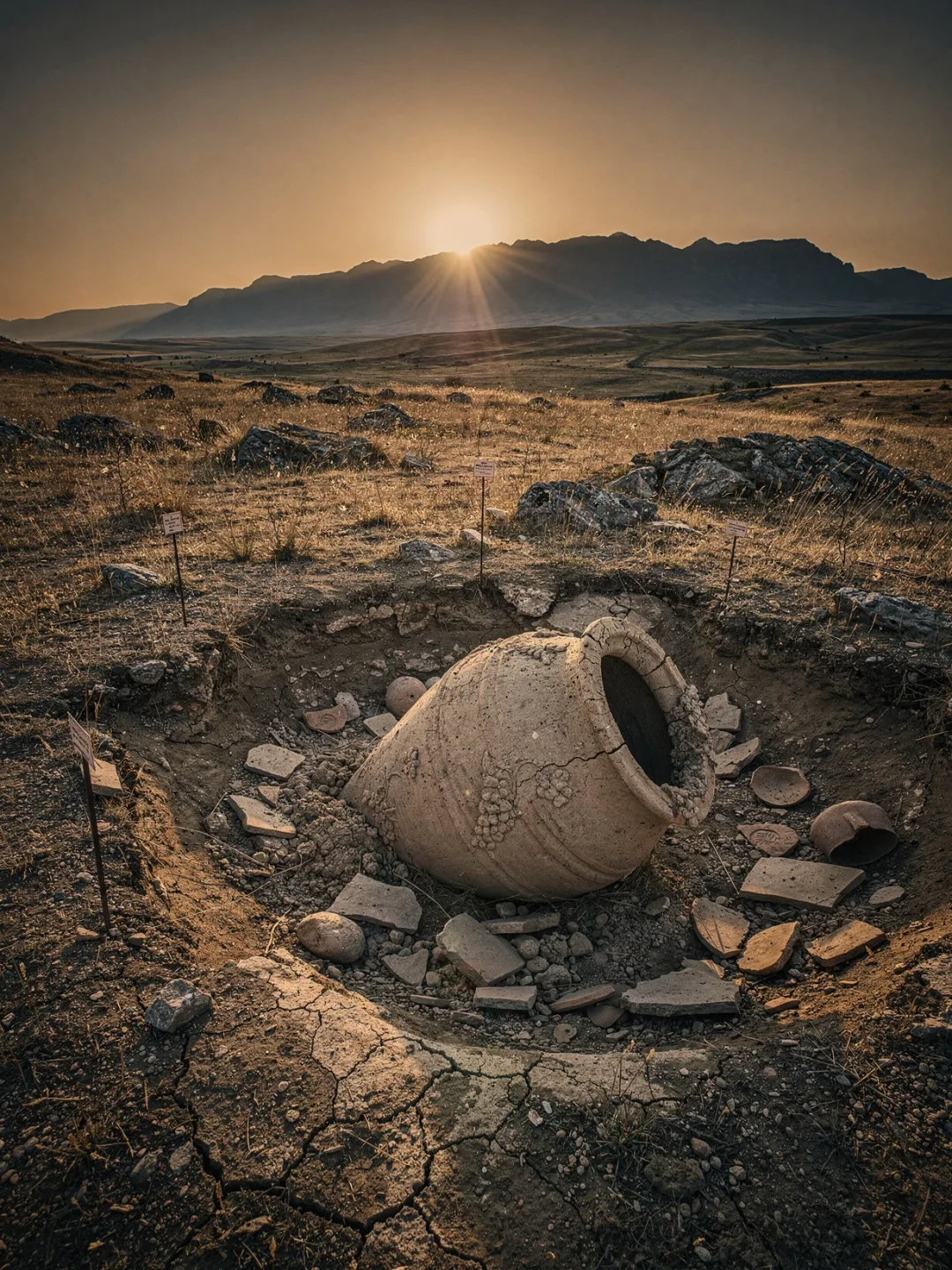
8,000 Years of Clay
Region & History
About thirty kilometers south of Tbilisi lies an unassuming hill called Gadachrili Gora. Archaeologists from the University of Toronto and the Georgian National Museum excavated pottery shards there from a settlement almost eight thousand years old. Tartrate residue, a byproduct of fermenting grape juice, was found lodged in the cracks of the shards. Researchers know of no older traces. Kartli, the broad plain around the Mtkvari River, has since been considered one of the places where humans first made wine.
In antiquity, the small kingdom on this soil was called Iberia; by the Middle Ages it was known as Kartli. Persians, Arabs, Mongols, and later Russians passed through, each bringing their own taxes and their own gods. The vineyard endured nonetheless. What survived was a particular method of vinification. Must and skins go into a bulbous clay vessel called a qvevri, which is buried in the ground. There the wine ferments and matures, shielded from frost and heat by nothing more than a few meters of earth. In 2013, UNESCO declared this method an Intangible Cultural Heritage of Humanity.
This order faced competition in the nineteenth century. Prince Ivane Mukhranbatoni, a descendant of the Georgian royal house of Bagrationi, had studied winemaking in Bordeaux and Champagne. In 1878, he pressed the first vintage of his new estate in the Mukhrani valley, using press, barrel, and bottle in the French style rather than the qvevri. His sparkling wine won the Grand Prix in Saint Petersburg in 1882 and a gold medal in Paris in 1889. To this day, the company Bagrationi 1882 produces sparkling wine using a similar method. In the village of Chardakhi, less than ten kilometers away, winemaker Iago Bitarishvili still ferments his Chinuri in buried clay vessels.
The Soviet era favored quantity over provenance, and many of the old varieties disappeared in favor of a handful of mass-market wines. Russia remained Georgia's most important buyer after 1991, until Moscow halted all imports in 2006, ostensibly over quality concerns but in truth for political reasons. Overnight, eighty percent of the market vanished. The industry had to find new buyers while raising quality, which had often suffered under labels like "Soviet Champagne." Out of this hardship came the protected designation of origin Ateni for Kartli's sparkling wine in 2007, and the designation Bolnisi for dry wines from the southern plain in 2018.