From Rome to DAC
Region & History
The Celts were already planting vines on the steep slopes above the Danube before Rome turned the area into a province. The Romans took over the vineyards and built a fort called Favianis on the river, on the site where the small town of Mautern now stands. It was there, in the fifth century, that a monk named Severin retreated, and his biographer noted tersely that he had gone "ad vineas" — into the vineyards. Three Latin words, the oldest written record of wine in the Wachau.
The real shaping of the valley came later, in the Middle Ages. Between 1000 and 1300, monasteries such as Melk and Göttweig, together with Bavarian landowners, carved the steep slopes into terraces. Every wall was built by hand, stone upon stone, without mortar. More than two million square meters of these dry-stone walls still stand today, and over forty percent of the vineyards rest on them. No bulldozer ever helped.
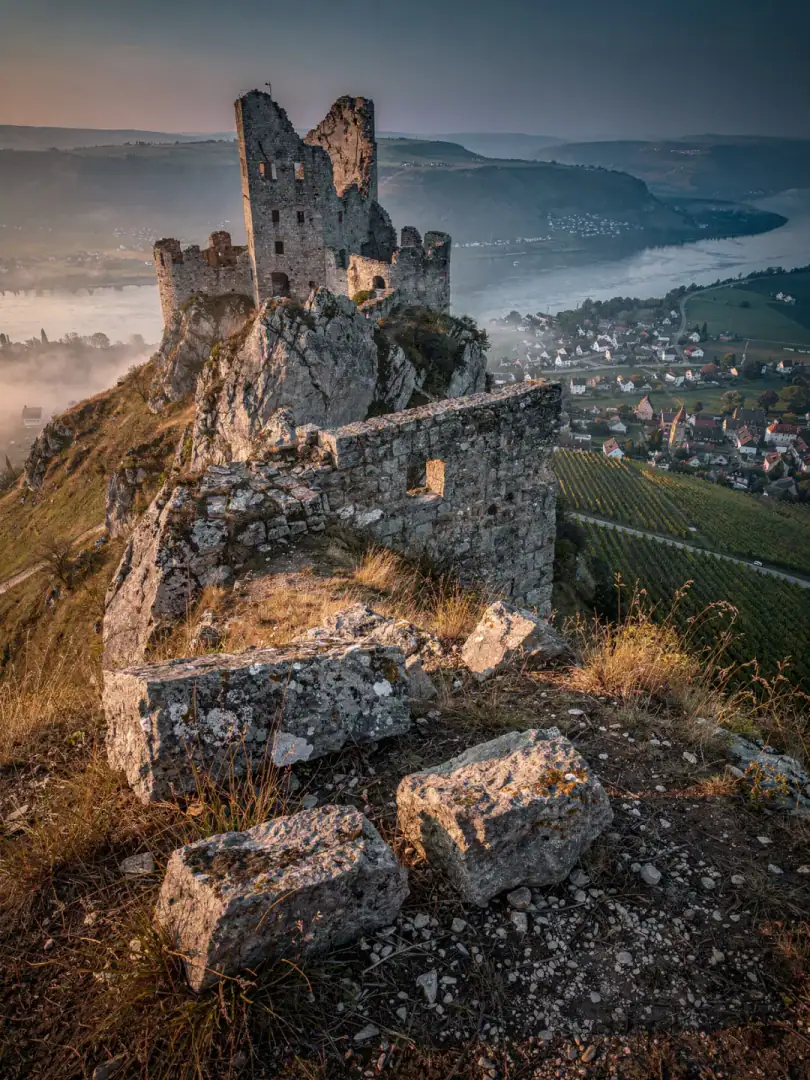
A famous story shows just how powerful the family watching over this valley once was. The Kuenringer clan guarded Dürnstein Castle, high above the river. In the winter of 1192, Duke Leopold V held a rather prominent prisoner there: Richard the Lionheart, King of England, captured on his way home from the Crusades. A vast ransom bought his freedom and financed the castle's expansion. Long before anyone thought of wine as an export good, money was already flowing into these walls.
The Wachau's modern identity grew out of a self-imposed code drawn up by four winemakers. Franz Hirtzberger, Josef Jamek, Franz Prager and Willi Schwengler founded the Vinea Wachau Nobilis Districtus association in 1983. When the EU began permitting so-called designer wine — industrially produced with added aromas and colorants — from 2006 onward, the association responded with the Codex Wachau, a written commitment to pure, unadulterated wine. It's here that the three names found on every wine list in the region come from: Steinfeder, Federspiel, Smaragd.
Two dates mark the finishing points. In December 2000, UNESCO declared the Wachau, together with the old town of Krems and the abbeys of Melk and Göttweig, a World Heritage Site, recognizing it as a living cultural landscape. Twenty years later, starting with the 2020 vintage, the region gained its own appellation system: Wachau DAC, with three tiers ranging from regional wine up to named single-vineyard wine. The two systems have coexisted ever since, and most producers use both.