Blends Conquer Scotland
The Coffey Still and Blends
In 1830, an Irish excise officer patented an invention that produced alcohol faster, cheaper and continuously, unlike any pot still. From this Coffey still came the light grain whisky – and from the blending of grain and malt, the blended whisky that made Scotland a global brand.
Aeneas Coffey Invents the Column Still
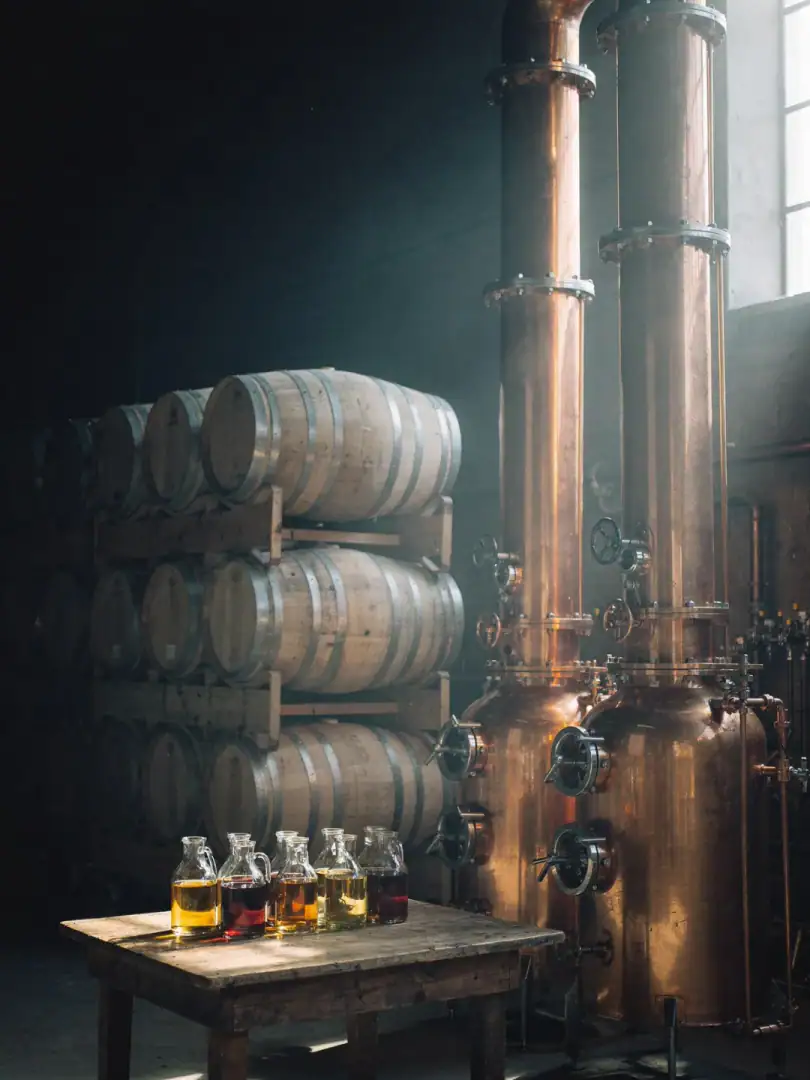
Aeneas Coffey worked as a customs inspector in Ireland and knew the distilling trade at close hand. He built on an earlier design by Robert Stein. In 1830, he developed it further into an improved, continuous still made up of two tall columns. Unlike a classic pot still, it didn't need to be emptied and refilled between runs. Wash flowed in at the top, and alcohol continuously flowed out at the bottom, day and night, without any pause between batches.
The process was many times faster and cheaper than the traditional double distillation in copper pot stills. It required less labor and produced a very pure, light alcohol, usually from corn or wheat rather than malted barley. This light, mild spirit is still called grain whisky today, in contrast to the more robust malt whisky from the pot still. Coffey first offered his invention to Irish and Scottish distillers. In Ireland, he found little interest, as distillers there took pride in their robust pot still tradition. In Scotland, too, many initially hesitated, fearing for their accustomed style, but adopted it soon after once they recognized the economic advantage.
Why Pure Malts Were Hard to Sell
Drunk neat, early Scotch malt whisky was, for many palates, too harsh, too smoky and too unpredictable in quality from cask to cask. For the English market, and even more so for export, this was a real problem. Customers outside Scotland wanted a flavor they could rely on, bottle after bottle, year after year.
This is exactly where enterprising merchants stepped in, particularly grocers with a good sense for both taste and trade. They began blending the mild grain whisky with more robust malt whisky from various distilleries. The result could be deliberately tuned to a specific, repeatable flavor. This was precisely the birth of blended whisky – a whisky made from several distilleries and several types of grain.
Names That Still Stand Today
Edinburgh merchant Andrew Usher is regarded as one of the first to commercialize such blends on a large scale, starting in the 1850s and 1860s. He was followed by names everyone knows today: John Walker and John Dewar, both originally merchants, not distillers by trade. What they sold above all was reliability, packaged in an attractive bottle with a recognizable label.
Their blends could be produced in large quantities while keeping quality stable for years. They tasted noticeably more approachable than pure malt and were easier to drink neat or with water. This allowed them to conquer markets that had previously remained closed to pure Scotch. First they won over England, then the entire British Empire, and finally the whole world. Sales representatives traveled with sample cases through colonies and port cities, from Calcutta to Cape Town, building lasting distribution networks along the way. These early export routes laid the foundation for what Scotch is known for today: a spirit available almost everywhere in the world.
Blended Whisky Becomes the Norm
By the end of the 19th century, the ratio had completely reversed. Blended whisky made up by far the largest share of Scottish exports. Most of what drinkers outside Scotland knew as Scotch was by then long since a blend, no longer pure malt. Single malt whisky became a niche product for connoisseurs, barely in demand among the broader public abroad. This shift coincided with a second event that once again massively fueled demand for Scotch: a tiny pest that was destroying entire vineyards in France.
How this natural coincidence catapulted Scotch whisky into a boom that no one could subsequently control is told in the next stop of this journey.