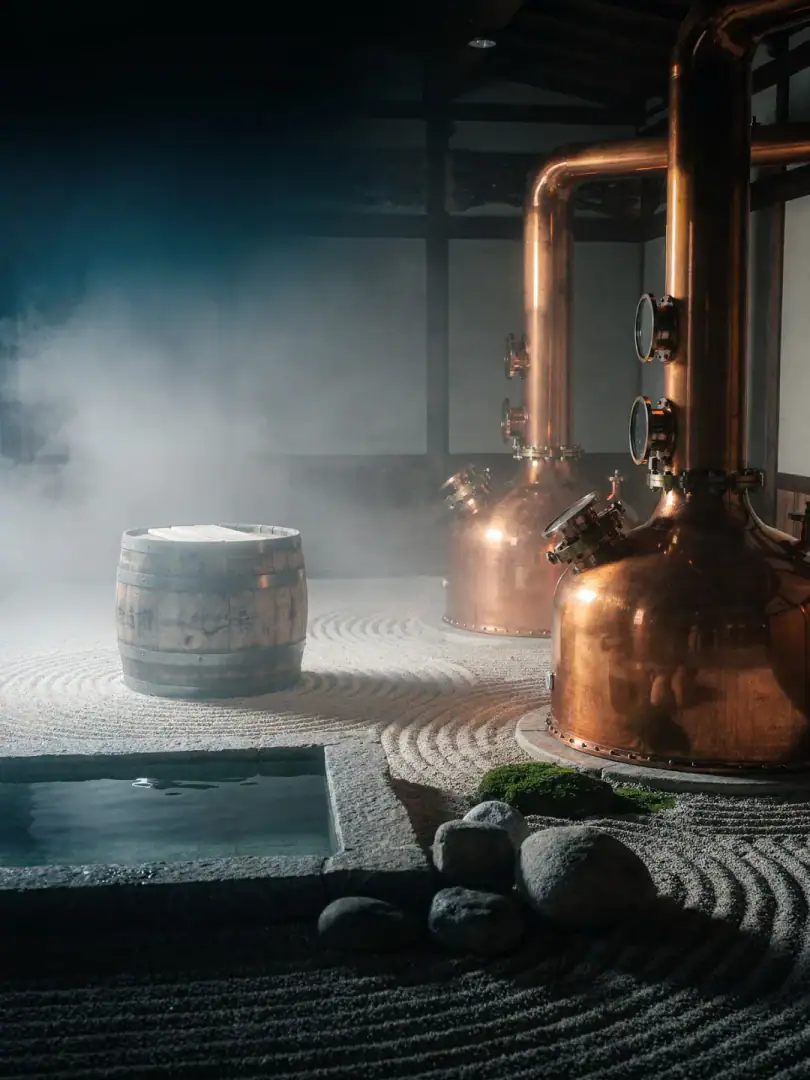
Taketsuru Meets Torii
Japan: Taketsuru and Torii
A young chemist from Japan traveled to Scotland, learned the craft there from the ground up, and brought home a Scottish wife. Out of this journey emerged two of the world's greatest whisky houses – and a whisky nation that today stands shoulder to shoulder with Scotland.
Masataka Taketsuru Learns in Scotland
Masataka Taketsuru came from a Japanese sake-brewing family and, starting in 1918, studied applied chemistry at the University of Glasgow. Rather than just studying theory, he sought out apprenticeships at Scottish distilleries. There he learned distilling, maturation, and blending firsthand. It was a training no Japanese person before him had undergone in such depth. Taketsuru worked, among other places, at the Longmorn and Hazelburn distilleries, closely observing every step of the process, from the mash to the finished cask.
In Scotland, he also met Jessie Roberta Cowan, known as Rita. He married her against the opposition of both families, who considered a union across continents unwise. In 1920, the couple returned together to Japan, where Rita henceforth led an unfamiliar, often difficult life as one of the first Western women in the country. Taketsuru brought back detailed notes on Scottish distilling methods. These notes are still regarded today as one of the first systematic Japanese documents on whisky production.
Torii Founds the First Distillery
In Japan, Taketsuru met Shinjiro Torii, a successful entrepreneur. Torii's company Kotobukiya, later Suntory, was already distributing imported wines and spirits and knew the Japanese alcohol market like no one else. He wanted to create a genuine Japanese whisky, not a mere imitation, and hired Taketsuru as head distiller for this ambitious project. For Taketsuru, it was the first opportunity to actually apply the knowledge he had gained in Scotland on a large scale.
Together, they chose a location called Yamazaki near Kyoto for the first distillery. They settled on it for its soft water and its humid, misty climate, which resembled the Scottish Highlands. Construction began there in 1923, and shortly afterward Japan's first whisky production got underway. This marked the birth of Yamazaki, to this day one of the most celebrated names in Japanese whisky and a destination for visitors from around the world.
Taketsuru Founds Nikka
The partnership between Taketsuru and Torii ended after a few years. The two men had different visions of what ideal Japanese whisky should be, and these differences proved impossible to bridge. Taketsuru went searching for a location that resembled the Scottish Highlands even more closely than Yamazaki. He found it in the north of the country: Yoichi, on the island of Hokkaido, with its cool climate, peaty soils, and proximity to the sea.
In 1934, he founded his own company there, later named Nikka. From the outset, Taketsuru placed great value on staying true to traditional Scottish methods. This included direct coal firing of the stills, a labor-intensive process that Nikka still maintains at Yoichi today, even though it demands considerably more effort than modern steam heating.
Two Houses, One Whisky Nation
The split between the two men didn't create rivals in any negative sense, but rather the two pillars on which the entire Japanese whisky industry still rests today. Suntory built its foundation on Yamazaki and later opened further distilleries, while Nikka staked its future on Yoichi and Miyagikyo. Over the decades, both houses refined distinct styles of their own. They drew inspiration from Scotland but adapted their methods to Japanese climate, Japanese water, and a distinctly Japanese sense of precision.
Internationally, Japanese whisky remained known to only a handful of connoisseurs for a long time, mostly travelers who had tasted it firsthand. It wasn't until international awards starting in the 2000s that the wider world took notice, including at prestigious tasting competitions where Japanese bottlings suddenly bested Scottish classics. Demand then surged so quickly that several well-known age statements temporarily vanished from the market, as stocks simply couldn't keep pace with the aging requirements. This late but all the more powerful recognition was part of a larger movement that was reinventing whisky elsewhere in the world at the same time.