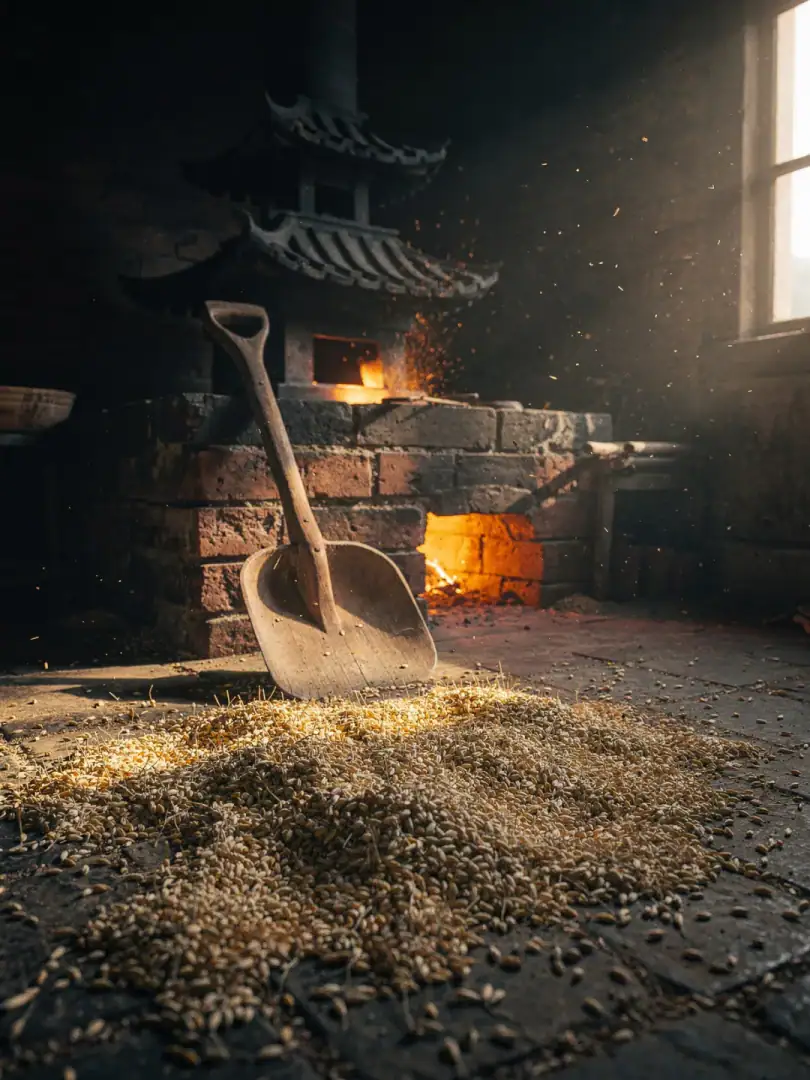
Smoke from casks
Malt & Peat
Peat, the kind Islay draws by the tonne from its own bogs, is practically nonexistent in usable quantities for malting in Wales. Anyone here who wants a smoky dram has to find another way.
Penderyn solves this by way of the cask. The young peated whisky spends time maturing in used Scotch casks that previously held peaty whisky, picking up some of that smoke character without a single gram of Welsh peat ever being burned.
When malting their own barley, the kiln therefore usually stays unpeated. The grain germinates, then is dried with hot air rather than peat smoke, preserving the pure grain flavour that Welsh distilleries want for their unpeated releases. At Aber Falls in the north, too, the kiln remains unpeated.
What stands in for smoke comes from the ground itself. Beneath south Wales's barley fields lies a thin layer of topsoil over firm glacial till from the last ice age, and beneath that the limestone through which the brewing water also seeps.
Penderyn Peated shows just how well this detour works. Connoisseurs can genuinely taste smoke, raisins and a touch of sweetness all at once, a result that comes more from the cask warehouse than the malting floor.
Dig through the layers beneath a Welsh barley field and you rarely find dramatic differences, more a slow transition from dark topsoil to lighter till and finally to solid rock. This very sequence helps determine how much water the roots can reach in summer and how soft the water tastes once it emerges from the spring. That, too, shapes the flavour in the glass, even though no smoke in Wales comes from its own peat bogs.
Thin, dark topsoil, where the barley for Welsh distilleries grows.
The root: Shallow barley roots draw water and nutrients here, entirely without peat.