Fish, cabbage, sails
Food & Beer Culture
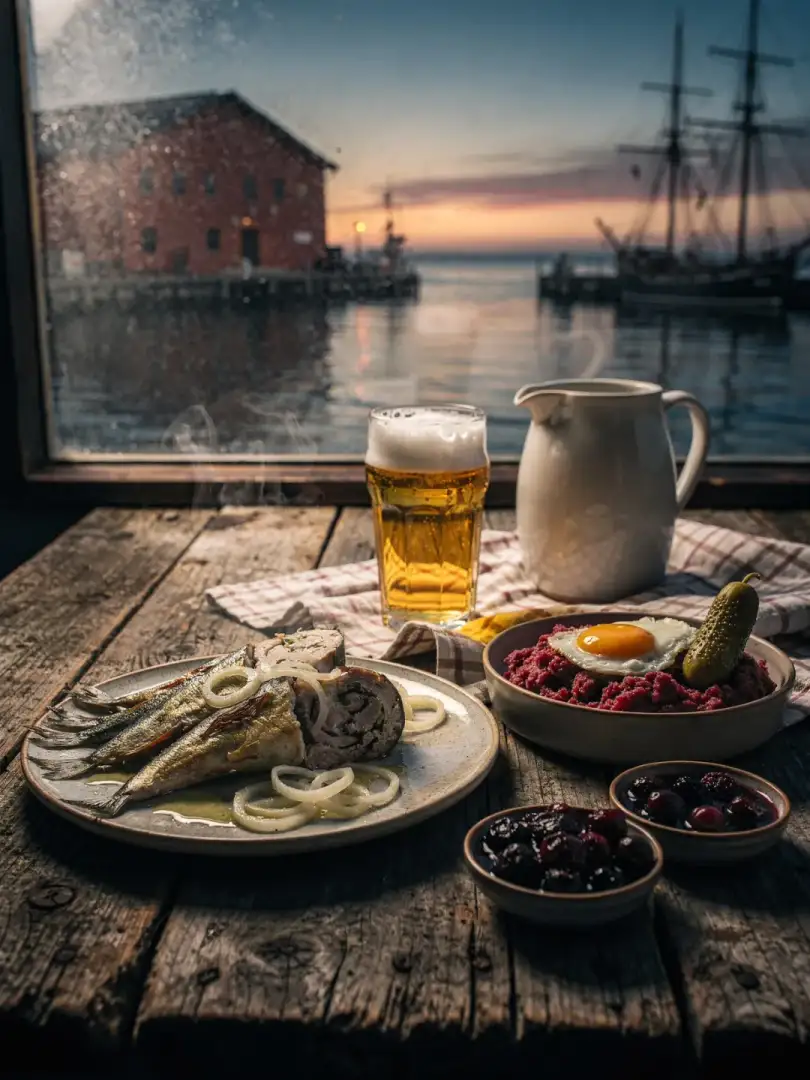
In the north, fish is the natural partner for a crisp Pils. The Kiel sprat, a small smoked herring, tastes salty and smoky, and the dry bitterness cuts right through the oily film on the tongue. Matjes herring and a fish roll from the coast also pair well, since the Pils doesn't overpower their acidity and salt.
Things get heartier with Labskaus, a dish of cured meat, potatoes, and beetroot that sailors brought into the ports. The carbonation in the Pils lifts the richness of the dish. In Dithmarschen, the region known for cabbage, Dithmarscher Kohl appears on the table as a stew or side dish with meat, and a beer with clean bitterness suits it well, never overwhelming the seasoning.
The Hanseatic legacy lives on in the food too. Lübeck traded in salt, and saltiness remains part of the local cuisine. For dessert, the region serves Rote Grütze, a tart fruit compote that has little to do with Pils, but everything to do with the north.
The biggest festival is Kieler Woche, which traces back to sailing regattas in the 19th century and is celebrated every summer in Kiel. Beer flows there as it does at any city festival, but the real stars are the boats out on the fjord.
The drinking culture here is calm and unhurried. You order a Pils at the bar and give the bartender time to pour it properly. Standard serving sizes are the 0.3-liter glass and the 0.33-liter bottle. Anyone driving opts for non-alcoholic beer, which in Germany can still be labeled "alcohol-free" up to 0.5 percent ABV.