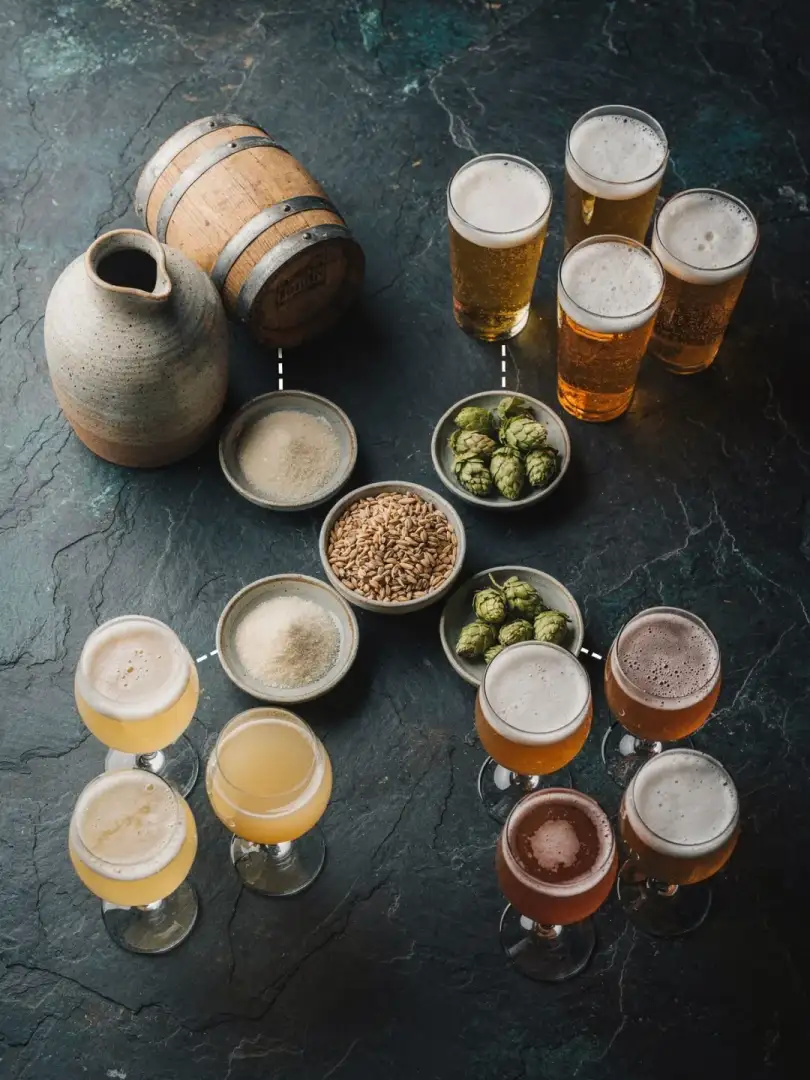
The family tree
What beer types are there?
There are hundreds of beer types, but they all belong to four major families: bottom-fermented, top-fermented, spontaneously fermented, and mixed-fermentation beers. What matters is the yeast and the temperature at which it works. Once you know this family tree, you can place any new beer in seconds.
What beer types are there? The family tree by fermentation
On the drinks menu, Pils, Weizen, IPA, Kölsch, and Stout all sit side by side as if they were equals. That's confusing. Clarity comes only when you ask which yeast fermented the beer and at what temperature. From this follow the four branches of the family tree, on which every beer style hangs. Color, strength, and bitterness, by contrast, are just the leaves: they distinguish styles within one branch but don't reveal which branch a beer belongs to.
A dark beer can be bottom-fermented like a Munich Dunkel or top-fermented like an Irish Stout. A pale, bitter beer can be a Pils or a Kölsch. So judging by the glass alone often leads you astray. Knowing the yeast usually gets you there.
Bottom-fermented beers: Lager, Pils, Helles, Bock
Bottom-fermenting yeast likes it cool. It works at temperatures around ten degrees Celsius and sinks to the bottom of the tank at the end of fermentation, hence the name. The beer then lagers—matures cold—for weeks afterward. This lagering process gave the whole family its international name: Lager. The cold slows the yeast down, so it produces hardly any fruity byproducts. What's left is a clean beer in which malt and hops come through clearly.
Biologically, lager yeast is a hybrid. Saccharomyces pastorianus, its scientific name, is a cross between the common brewer's yeast Saccharomyces cerevisiae and the cold-loving species Saccharomyces eubayanus, first described in Patagonia in 2011. The first pure culture—a yeast grown from a single cell without foreign microbes—was achieved by Emil Christian Hansen in 1883 at the Carlsberg laboratory in Copenhagen. Bottom-fermented brewing, of course, had long been practiced in Bavaria before that.
This branch includes Pils, Helles, Export, Märzen, Festbier, Dunkel, Schwarzbier, and Bock, along with most of the beers found on supermarket shelves worldwide.
Top-fermented beers: Ale, Weizen, Kölsch, and Altbier
Top-fermenting yeast is the brewer's older partner. It works warmer, roughly at room temperature, and rises to the top in open vessels along with the foam, where brewers once skimmed it off. Warmth makes the yeast chatty: it produces esters, fruity aromatic compounds reminiscent of banana, pear, or stone fruit. Some strains also yield phenols, spicy compounds with a clove-like note.
In English, this family is called Ale. It includes Pale Ale, IPA, Porter, and Stout, as well as the German top-fermented styles: Weissbier, Kölsch, Altbier, and Berliner Weisse. Kölsch and Altbier show that the boundaries can blur, since they ferment top-fermented but then mature cold like a lager. The branch even matters legally. German beer law allows top-fermented beers to use malts other than barley, such as wheat or rye, plus certain sugars; only Bavaria bans the sugar.
Spontaneous and mixed fermentation: the sour branches
The third branch does without cultivated yeast altogether. For Belgian Lambic, the wort—the hopped malt liquid before fermentation—cools overnight in a shallow, open vessel. Wild yeasts and bacteria from the air settle in during this process. Fermentation then takes months to years and finishes dry and tart. Experts call this spontaneous fermentation.
Mixed-fermentation beers sit in between. The brewer deliberately adds yeast and lactic acid bacteria, as with Berliner Weisse or Gose. Or the beer matures in wooden barrels inhabited by microbes, as with Flanders Red Ale. Here, acidity isn't a flaw—it's the point.
Beer type, beer style, beer category: what's the difference?
In everyday speech, these three terms get mixed up. Strictly speaking, a beer style describes a flavor profile along with its ingredients, process, and typical measurements. The most widely used catalog for this comes from the US: the guidelines of the Beer Judge Certification Program, or BJCP, describe exactly 110 styles in their 2021 edition. They're meant as a guide for competitions, not as law.
A beer category, by contrast, belongs to German law. The Biersteuergesetz (beer tax regulation) classifies beer by original gravity—the proportion of dissolved substances from the malt in the wort before fermentation. Below 7 percent, it's classified as beer with low original gravity; from 7 to under 11 percent, as Schankbier (draft beer). From 16 percent upward, terms like Starkbier (strong beer) or Bockbier are permitted. A typical Pils falls in between at 11 to 12.4 percent; the old term Vollbier (full beer) is customary here, though the regulation itself doesn't require this designation.