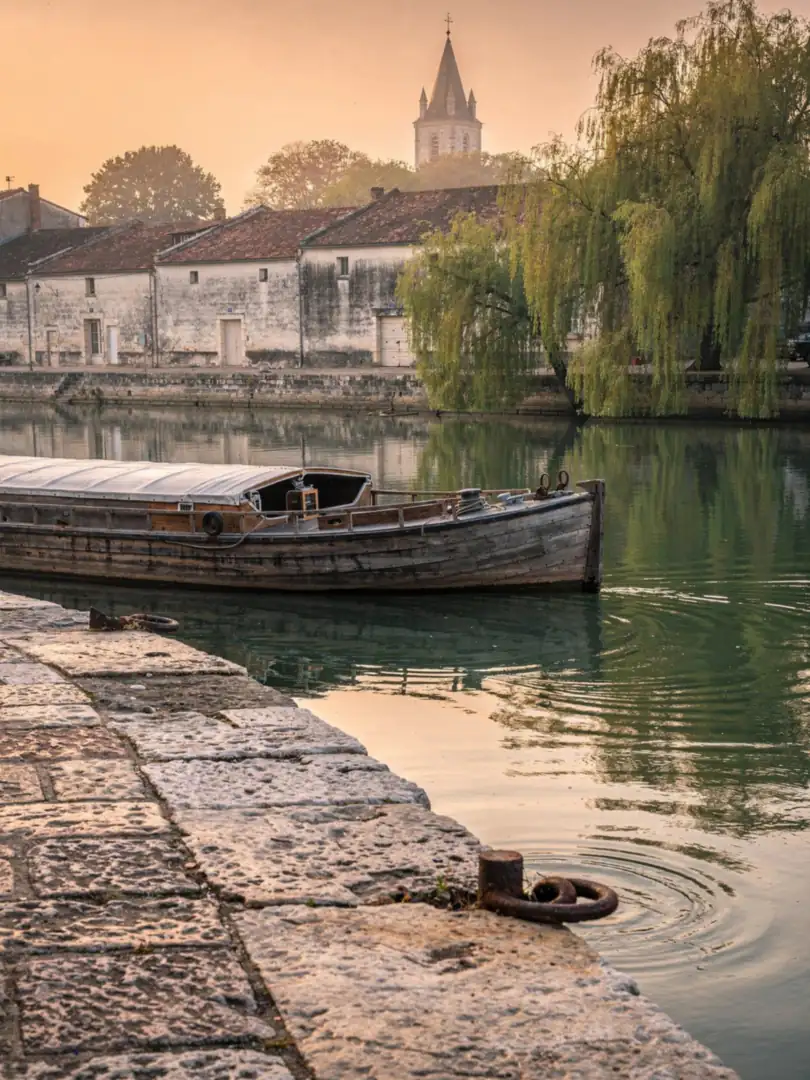
River, Merchants, Houses
Region & History
Where does Cognac come from? From the Charente valley in southwest France, where the river flows past the towns of Cognac and Jarnac on its way to the Atlantic. In the 16th and 17th centuries, Dutch merchants came here to collect salt and wine. Because wine didn't travel well by sea, they had it distilled and called the result brandewijn, burnt wine. From this came the English word 'brandy.'
The region turned this into a craft of its own. According to the trade body BNIC, double distillation became established in the 17th century, a method known today as Charentais distillation. The Charente remained the trade route throughout: wine and spirit travelled down the navigable river to the ports on the coast.
Several of the great Cognac houses can be traced back to settlers who arrived from elsewhere. Jean Martell, born on the Channel Island of Jersey, opened his house in Cognac in 1715, with Rémy Martin following in 1724. The Irishman Richard Hennessy founded the house of Hennessy in 1765, and Camus joined the scene in 1863, remaining in family hands to this day. A little further upriver lies Jarnac, home to Hine and Delamain, both founded in 1763, as well as Courvoisier, whose roots, according to the company, lie in Paris in 1809, and which has been based in Jarnac since 1835.
Today the owners are international. Martell belongs to Pernod Ricard, Rémy Martin to Rémy Cointreau. Hennessy sits within Moët Hennessy, in which LVMH holds 66 percent and Diageo 34 percent. Courvoisier was sold to Campari Group in May 2024 for around 1.2 billion US dollars.
The BNIC counts 251 houses, 4,252 growers and distillers, and 131 professional distillers. The name Cognac is protected as a designation of origin and applies only to spirits from the defined area along the Charente. In 2025 sales fell by around 15 percent, with the trade body citing tariffs in China and the US as the reasons.