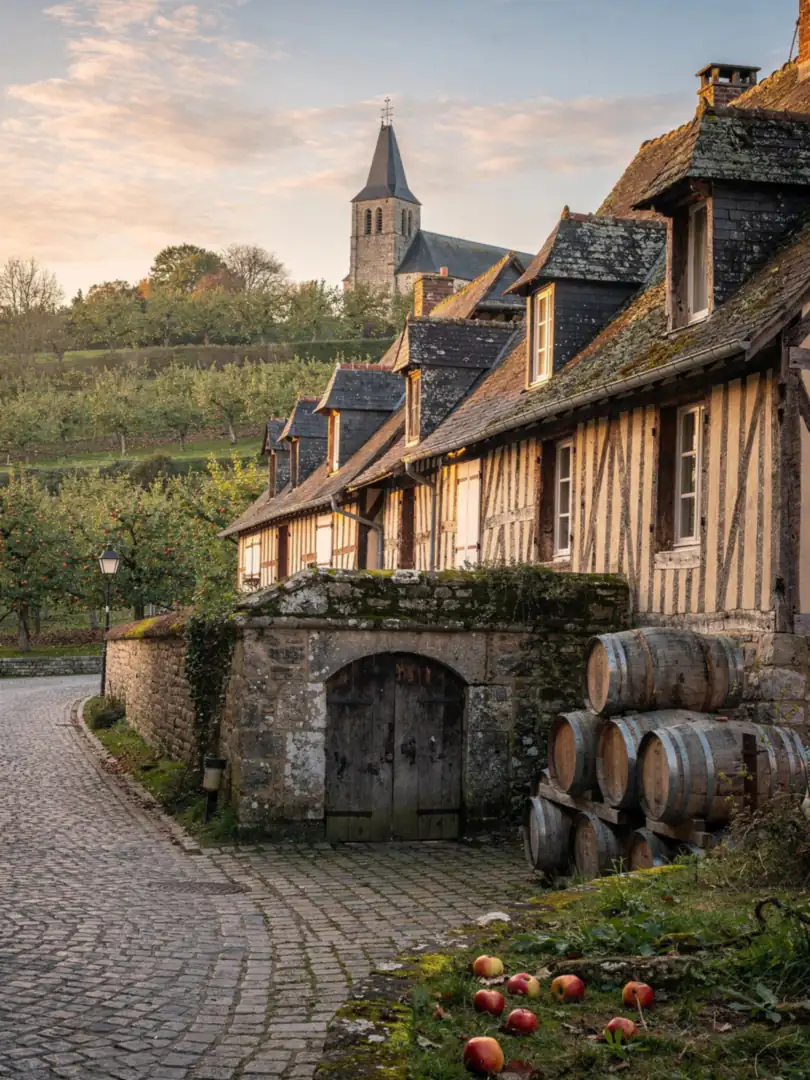
Hills, Farms, Houses
Region & History
Driving through the Pays d'Auge from Pont-l'Évêque toward Cambremer, you'll see more apple trees than fences. The hills of eastern Normandy, clay and limestone under a damp maritime climate, are home to Calvados Pays d'Auge, the appellation with the strictest rules of the three Calvados designations.
What's the difference between Calvados and Calvados Pays d'Auge? Both are brandies made from cider (cidre) and perry (pear wine), but standard Calvados can be distilled either in a pot still or a column still. In the Pays d'Auge, only double distillation in a pot still is permitted, pears may make up no more than 30 percent of the raw material, and the brandy must age in oak casks for at least two years. A decree dated September 11, 1984 sets out these rules, and the EU recognizes the name as a protected geographical indication.
Distilling happened on the farms long before labels ever existed. From the cidre already sitting in the cellar, farmers made a spirit that kept far longer than the cidre itself. The first houses to turn this into a business emerged in the 19th century. Père Magloire in Pont-l'Évêque dates its distilling origins to 1821, Boulard cites 1825, and at Clos de la Hurvanière in Saint-Cyr-du-Ronceray, Pierre Groult began commercial distilling in 1860.
A more recent chapter begins with Christian Drouin. In 1960, he bought a farm near Coquainvilliers with orchards already planted, and initially had the cidre distilled by a traveling distiller. According to the house, sales only began in 1979, once his son had built up the brand.
Today, family houses like Groult and Drouin stand alongside Père Magloire, which belongs to Spirit France. Visiting them one after another reveals just how differently the same rules can be interpreted: casks and flavor diverge, while the basic framework stays the same.