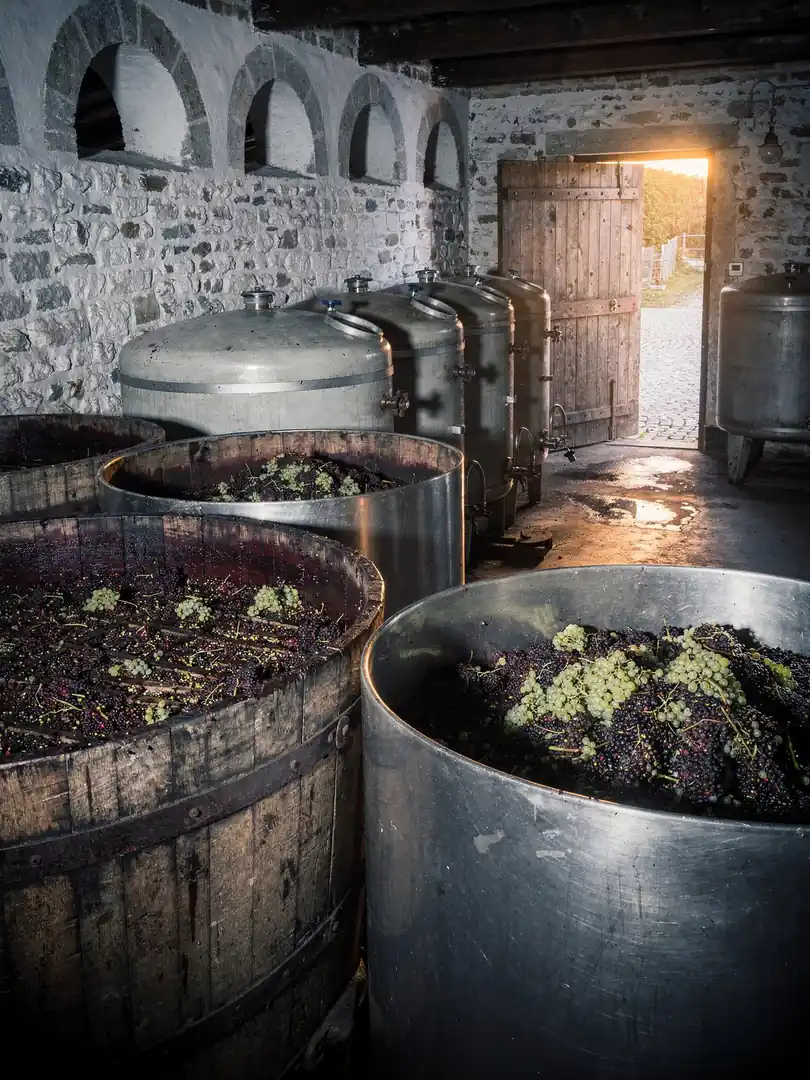
Pomace Under Lock and Key
Mash & Fermentation
Fresh pomace spoils quickly, so in Friuli every hour between pressing and distilling counts. Nonino states its principle as distilling the pomace within a few hours. Anyone unable to distil immediately must store it, and that is when the real work on the mash begins.
To do this, the pomace is compacted and sealed airtight. Oxygen allows acetic bacteria and mould to grow, robbing the eventual spirit of finesse — so the covering is sealed with care. Shut away from air, yeasts convert the remaining sugar into alcohol. For white pomace this is the entire fermentation; for red, only the final stretch.
The yeasts often come from the grapes themselves, though some producers use cultured yeast. Duration depends on sugar content and warmth, ranging from a few days to several weeks. Cool storage ferments slowly, helping to preserve volatile aromas such as blossom and fruit.
Fruit works differently. Pears and cherries are crushed and fermented in their own juice. For Kirsch Friulano, the pits should stay as intact as possible, since crushed stones release hydrocyanic acid, from which ethyl carbamate — a suspected carcinogen — can form in light. A faint note of almond is enough. For Sliwovitz del Friuli-Venezia Giulia, the specification allows the mash to be prepared with or without the stones.
Methanol forms in every mash from the pectin in the fruit's cell walls, not only during distillation. That is why EU law sets maximum limits: 1,000 grams per hectolitre of pure alcohol for pomace brandy, and 1,000 to 1,350 for fruit brandy, depending on the fruit. The real danger lies in adulterated alcohol, not in a properly made spirit within these limits. Distilling without a licence is illegal in Germany, and elsewhere, too, it remains the preserve of licensed producers.