A Historic Document and a Family Business
Region & History
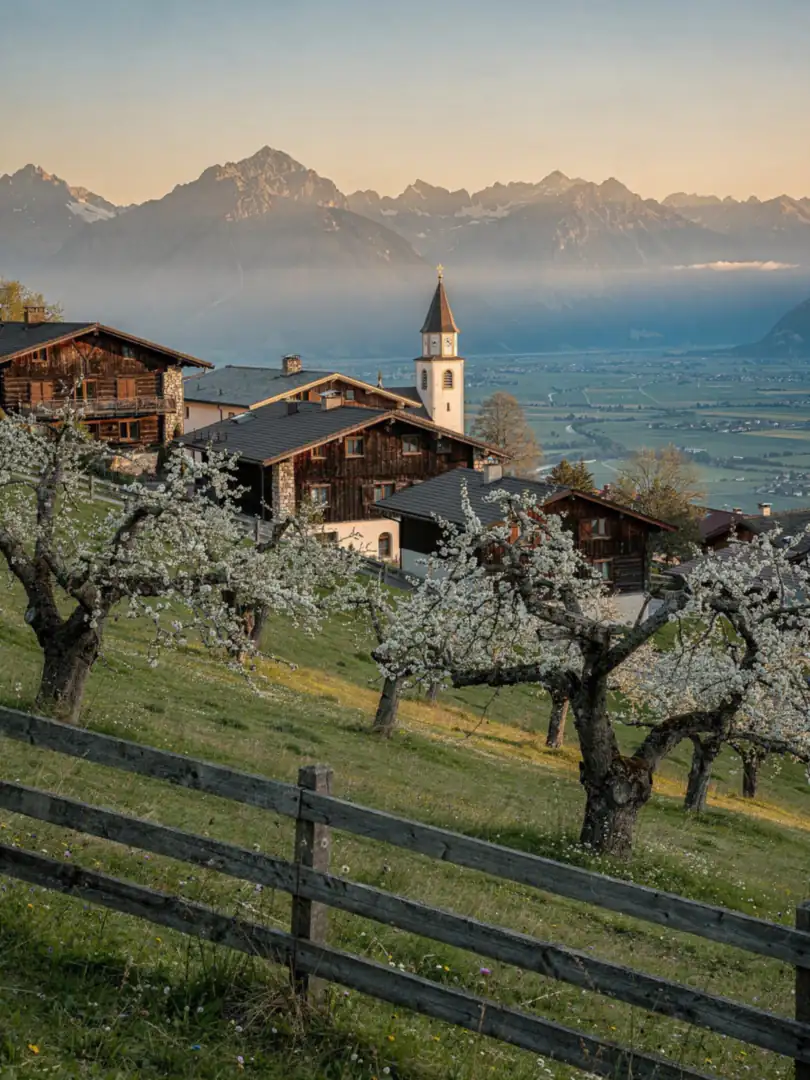
Driving up to Fraxern, you leave the Rheintal valley behind and find yourself at roughly 1,000 meters on a south-facing slope where, surprisingly, many cherry trees grow. The Fraxner cherry already appears in a document from 1574, spelled 'Khriespern'. The dialect word Kriasi for cherry traces back to the French 'cerise'.
What exactly is Fraxner Kirsch? A kirschwasser, that is, a fruit brandy made from fermented cherries, known locally as Fraxner Kriasiwasser. With the mechanization of distilling in the 19th century, distilling became more widespread in this mountain community. According to the Ministry of Agriculture, around 35 farm-based distillers from Fraxern are involved.
Unlike Schwarzwälder Kirschwasser, Fraxner Kirsch carries no EU geographical indication. Instead, it's listed in the Ministry's register of traditional foods, which documents traditional production methods and origin.
Down in the Rheintal valley, the Freihof distillery grew out of the 'Zum Freihof' inn in Lustenau, founded in 1885 and still family-owned today. In the same town, the private distillery Gebhard Hämmerle operates, whose Williams pear brandy is traded internationally.
In Hörbranz, the Prinz family has run their distillery, by their own account, since 1886, now in its fourth generation. What began as a farm with a small inn grew into a cooperage, a pressing house, and finally a distillery.
One peculiarity is the right to distill for personal use. The tax-free home distillate is capped in Austria at a maximum of 27 liters of pure alcohol per agricultural household, but in Vorarlberg up to 50 liters are allowed, with 6 liters per person. Distilling still requires registration with the customs office.