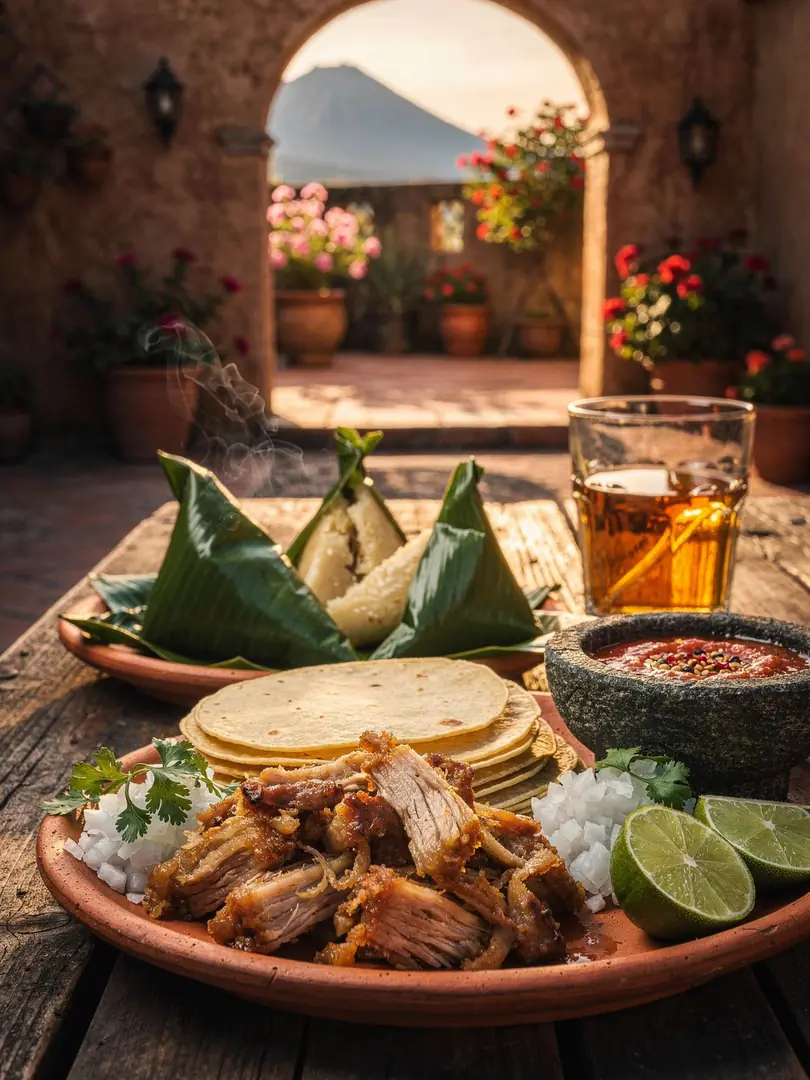
Tamales and Carnitas
Food & Drinking Culture
Michoacán's cuisine has been on UNESCO's Intangible Cultural Heritage list since 2010, as part of traditional Mexican cuisine. This is the best context for placing Charanda: a regional spirit alongside regional food. The dishes grow from the corn the Purépecha have cultivated for centuries, and from pork.
Carnitas are said to have been invented in Quiroga. Pork is cooked for hours in large kettles in its own fat, then served in pieces. A clear spirit with acidity or lime suits the rich, savory meat better than a heavy, sweet one.
Corundas are triangular tamales made of corn dough, wrapped in corn leaves and steamed. The name comes from Purépecha, where k'urhaunda means tamal. Uchepos are made from fresh corn rather than dried, and often taste sweet. Churipo is a meat stew. The sweetness of an aged Charanda pairs well with these gentle corn dishes.
No set drinking tradition for the region has been recorded, and anyone mixing Charanda treats it like a juice-based rum: lime, sugar, soda, mint. The logic is familiar from Ti' Punch and Caipirinha, whose recipes appear elsewhere. The spirit also works well neat, for warming up on a mountain slope.
Charanda feels most authentic as part of a meal: tamales first, then the meat, followed by a small sip to finish. This way, the spirit matches the cuisine it comes from and remains a companion rather than a backdrop for cocktails. No fixed regional cocktail has been recorded.
Uruapan itself lies within reach of the Paricutín volcano, which emerged from a cornfield in 1943; the municipality of Nuevo Parangaricutiro belongs to the Charanda zone. Amid ash cones, avocado orchards, and red fields, one can see where the spirit comes from: a landscape shaped by the volcano.