Loess and Volcano
Soil & Climate
The Kaiserstuhl, visible on the horizon from Breisach, is one of the warmest regions in Germany. To the west, the Vosges Mountains intercept much of the rain, and the Rhine plain in front of them warms up early and strongly in summer. For wines meant to be rich and fruity, this is a blessing.
For sparkling wine, that same warmth is more of a challenge. Sparkling wine needs freshness and acidity. The warmer the site, the faster sugar rises in the berries and the quicker acidity drops. That's why sparkling wine producers in Baden pick their grapes early, well ahead of the normal harvest, while the berries still taste taut and zesty.
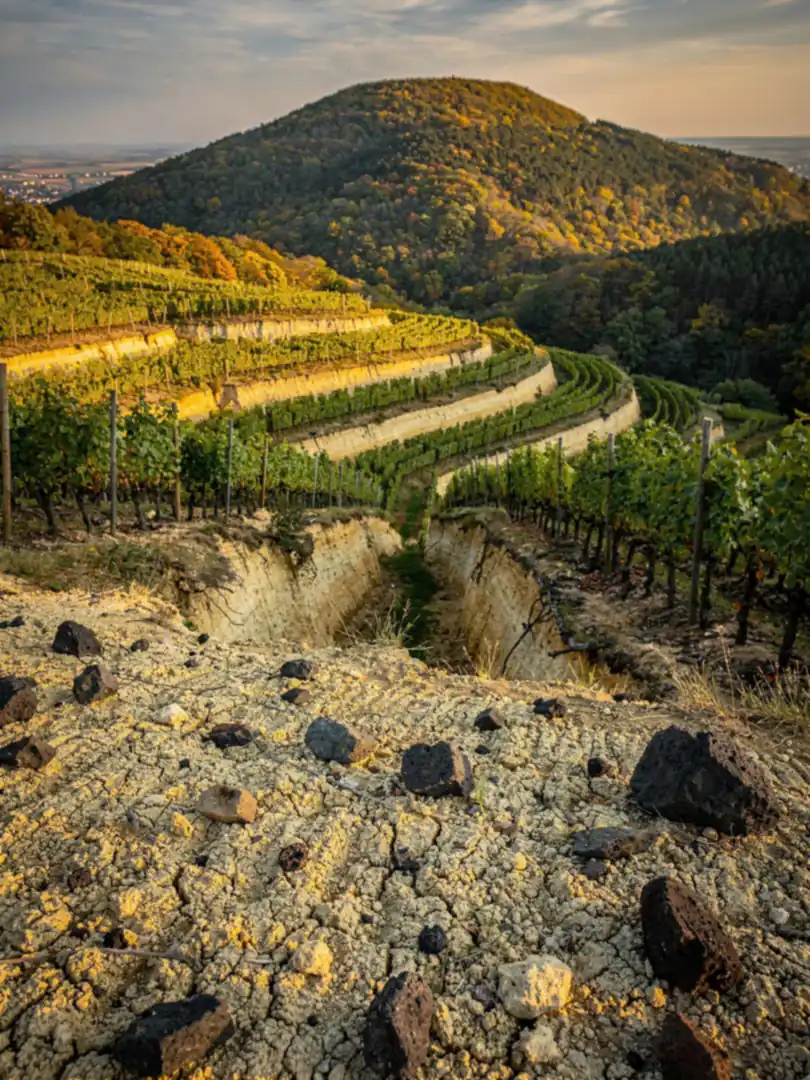
The Kaiserstuhl is an extinct volcano. Its slopes consist of volcanic rock that rose up millions of years ago, and of loess, a fine dust deposited by the wind. Loess retains water well and is easy for roots to penetrate, while dark volcanic rock stores the sun's warmth. The mountain remains the backdrop here; the sparkling wine cellars lie in the town on the Rhine.
Beneath Breisach, another chapter of the story begins. Geldermann ages its sparkling wine in vaulted cellars dating back to the 15th century, maintained at a constant 13 degrees according to the Black Forest tourism office. This matters because the more consistent the coolness, the more even and gentle the second fermentation in the bottle becomes. The result is finer bubbles.
Unlike the Grand Cru list of Champagne, there is no ranking of villages for sparkling wine from Baden. The cuvée is often made from grapes sourced from several places, soils, and slopes. Anyone wanting to know exactly where the grapes came from can at least find the producer's name on the label of Winzersekt (grower's sparkling wine).