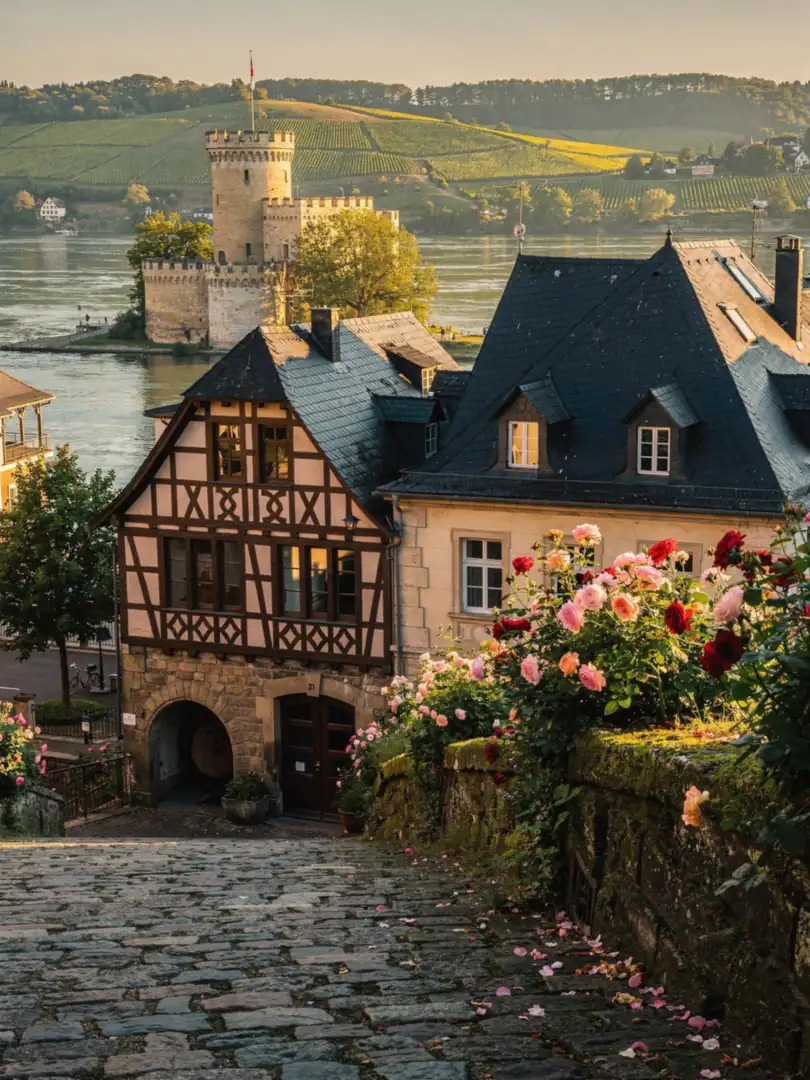
Sekt City Eltville
Region & History
Eltville am Rhein carries the nickname Sekt City, and there's more behind it than a marketing label. Matheus Müller, born in 1773 and died in Eltville in 1847, built a sparkling wine business here. The house behind the MM brand is usually dated to 1838.
In the 19th century, a small cluster of Sekt houses sprang up along the Rhine bank, among them, according to local tradition, Matheus Müller, Mumm, and Schloss Vaux. The MM Sekt cellar still sits in Eltville today. Rotkäppchen-Mumm bought the Mumm, Jules Mumm, and MM brands from Seagram on January 16, 2002, and MM Extra has belonged to the group ever since.
Schloss Vaux has had quite a journey. According to the house, the company was founded in Berlin in 1868 and later acquired the Château Vaux near Metz along with its vineyards. The Sekt cellars stayed there for forty years, until the estate, which had by then become French, had to be given up, and the operation moved to Eltville. In 1982, a group of friends bought Vaux from a subsidiary of Dresdner Bank, and today around sixty shareholders share ownership of the house.
What "Rheingau" on a Sekt label actually means is governed by law. A Sekt b.A. comes from one of Germany's 13 wine-growing regions and carries an official quality control number. The term Winzersekt may only be used, under § 34a of the German Wine Ordinance, by producers who grow their own grapes, make the wine in-house, ferment it traditionally in the bottle, and list both grape variety and vintage on the label. A Sekt without this designation, by contrast, may be made from base wines sourced from other EU countries.
The growing region stretches roughly 50 kilometers along the right bank of the Rhine as far as Lorch and covered around 3,117 hectares of vineyard in 2025.