Loess, Clay, Quartzite
Soil & Climate
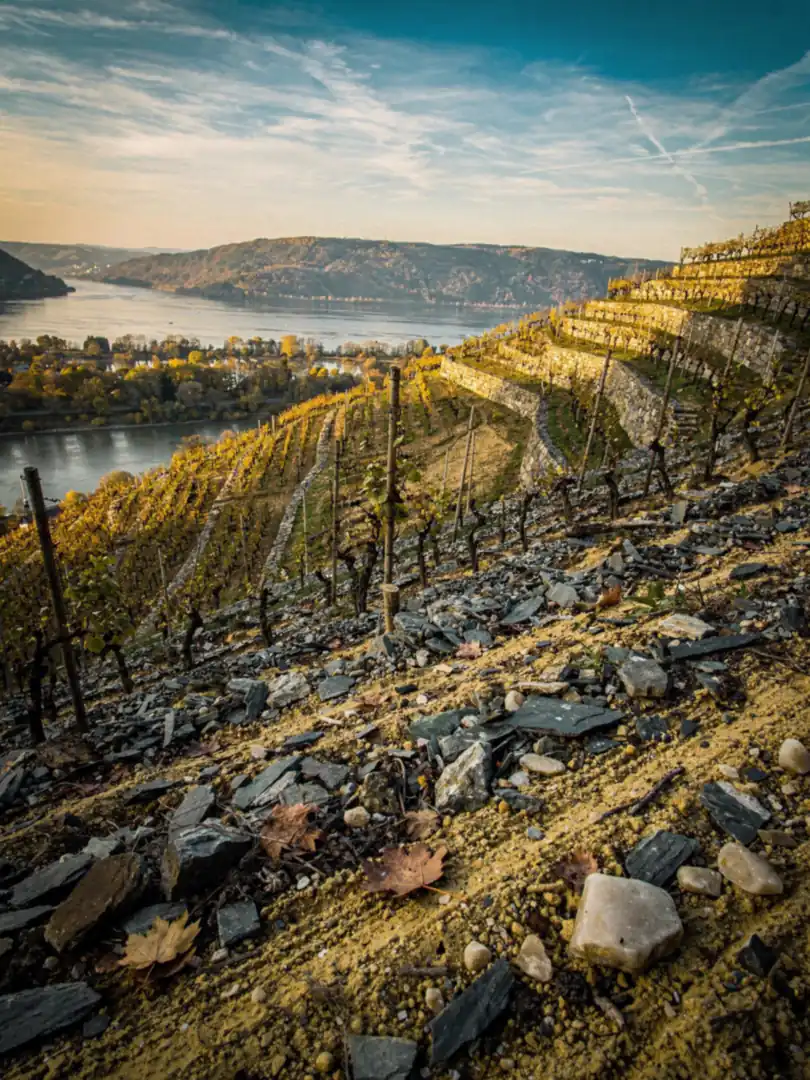
The Rhine flows unusually from east to west through the Rheingau, which means the vineyard slopes on the right bank face south. Even so, Sekt grapes don't need blazing sun. What's wanted are grapes that keep healthy acidity alongside moderate sugar levels, since these become the base wine.
The soil changes from slope to slope. Heavy clay and loess soils sit alongside quartzite and weathered slate. Loess is a fine, wind-deposited dust that holds water well and produces fuller-bodied Rieslings. Quartzite and slate tend to yield firmer wines with a stony edge, prized as a base for Sekt.
At the western end of the region lies the Rüdesheimer Berg Schlossberg, a steep site that produces single-vineyard Sekts such as the one from Balthasar Ress. Under § 34b of the Wine Ordinance, a Sekt b.A. may even be labeled "Steillage" (steep slope) if the grapes come from vineyards with at least 30 percent gradient. That means hand labor on the slope, and it takes time.
The climate helps Sekt production, as long as it doesn't get too warm. The broad river moderates both frost and heat, while cool nights preserve acidity in the berries. Base wine for Sekt is harvested considerably earlier than wine meant to remain still, since Sekt producers pick for acidity rather than must weight.
There are no chalk tunnels here as in Champagne. What matters for the lees aging is simply that the cellar stays cool and consistent, around 13 degrees Celsius, so the second fermentation proceeds slowly and the fine bubbles stay locked into the wine. Eltville am Rhein sits right in the middle of the region, so the path from grape to press is short.