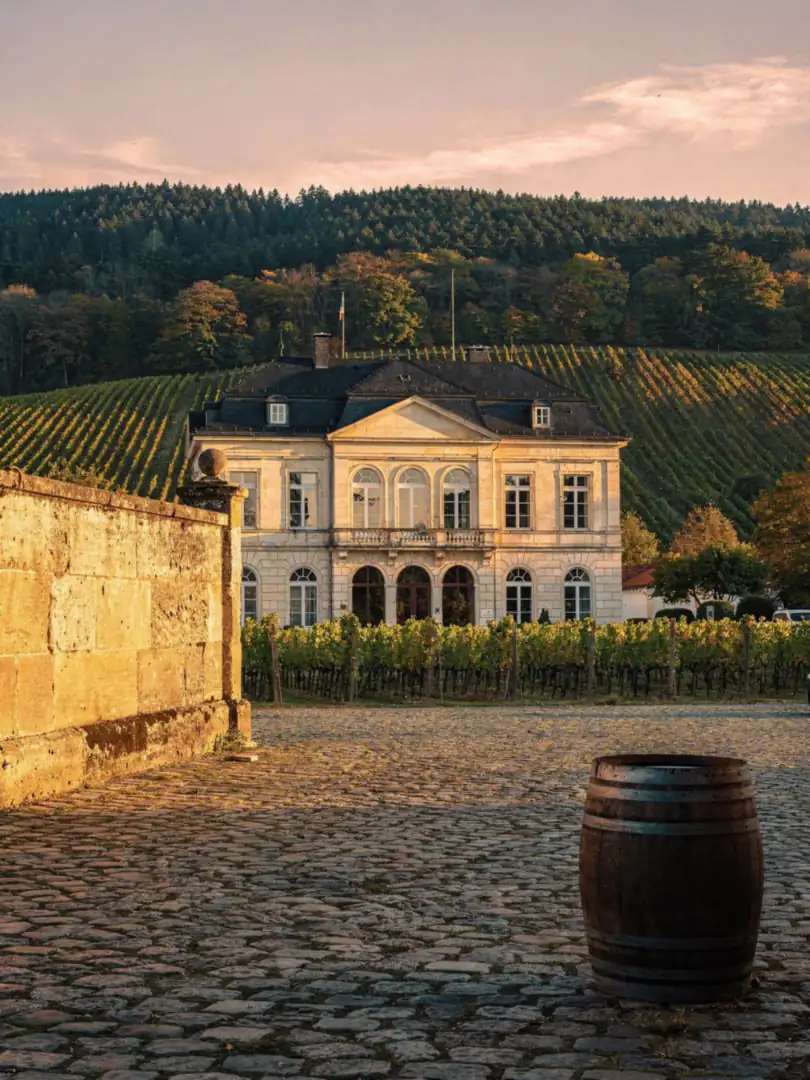
Wachenheim and Deidesheim
Region & History
Schloss Wachenheim Sekt comes from the Pfalz, from the wine town of Wachenheim on the Deutsche Weinstraße south of Bad Dürkheim. The house was founded in 1888. According to the company, founder Carl Joseph Wagner managed to bring bottle fermentation, as known from Champagne, to the Rieslings of the Pfalz. For the late 19th century, that was an ambitious move.
What began as a Sekt cellar has grown into a corporation. By its own account, Schloss Wachenheim today ranks among Europe's major producers of Sekt and sparkling wine, and the range also includes dealcoholized sparkling wines. Yet under the same name you'll still find Riesling Sekt labeled with traditional bottle fermentation.
Deidesheim tells a quite different story. Here stands the Villa im Paradies, built in 1838 in the style of a Florentine palazzo. Klaus Menger-Krug and Regina Motzenbäcker met while studying in Geisenheim. In the late 1970s, they set out to make top-tier Sekt from German wines using the traditional method—a bold venture at the time. In 1981 they presented their first Sekt. Today, the family runs two wine estates and a Sekt house, by their own account.
Between corporate brand and grower's house, the law translates the differences onto the label. Anyone wanting to know what sets Sekt b.A. from the Pfalz apart will find it in German wine law: a Sekt may carry that designation once it has received an official approval number. Winzersekt, by contrast, requires grapes and winemaking from a single estate, traditional bottle fermentation, plus grape variety and vintage stated on the label.
The vineyard land behind all this is extensive. At 23,445 hectares, the Pfalz is Germany's second-largest wine region. Some 144 wine villages line the roughly 85-kilometer Deutsche Weinstraße, giving Sekt producers plenty of wine to choose from.