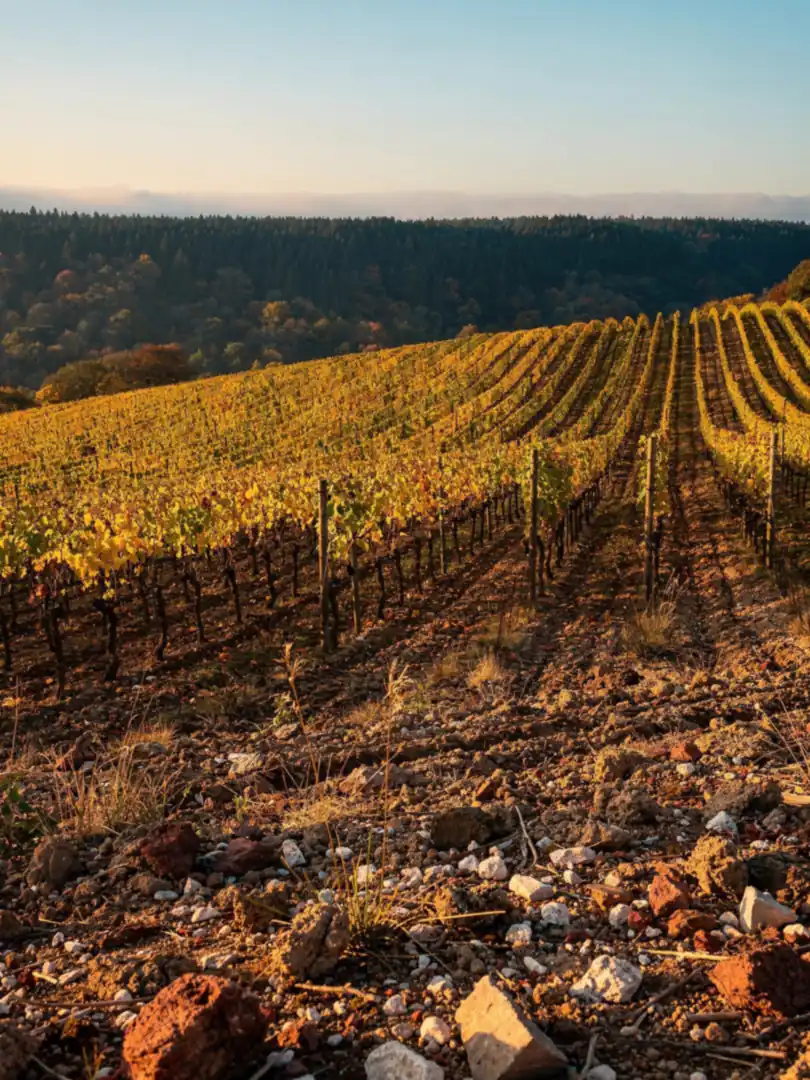
Haardt Hills and Red Sandstone
Soil & Climate
The Pfalz splits roughly into two halves. To the north lies the Mittelhaardt, stretching broadly from Neustadt an der Weinstraße to the Zellertal near Worms. To the south follows the Südliche Weinstraße. Wachenheim and Deidesheim—the two names most associated with Pfalz Sekt—both belong to the Mittelhaardt.
Behind the vines rises the Pfälzerwald, which catches much of the rainfall. The vineyards at the foot of this low mountain range therefore count among Germany's milder sites. A mild climate means grapes ripen reliably. But for Sekt, that's only half the equation, since base wine needs to stay fresh and high in acidity.
This is where the soil helps. In the higher sites, vines grow on red sandstone (Buntsandstein), yielding robust, mineral-driven wines. At mid-elevations lies shell limestone (Muschelkalk), which Pfalz wine marketing links to elegant acidity. Then there's loess and calcareous clay. In the south, the soils grow heavier, with granite appearing in places.
A Sekt maker can use this like a mixing board. Riesling from sandstone brings structure, Riesling from limestone brings freshness, and blending the two can create a cuvée that outperforms either lot alone. This is especially true for houses that buy or own grapes from multiple sites.
There's no chalk cave here like in Champagne. Instead, it's the cellar a house builds or expands—and above all its steady coolness—that matters. Where bottles rest on the lees for months, every degree of reduced fluctuation counts. That's why vaulted cellars are so prized among Sekt houses, and a visit there feels like an excursion into stillness.