Sekt from the Elbe Slopes
Region & History
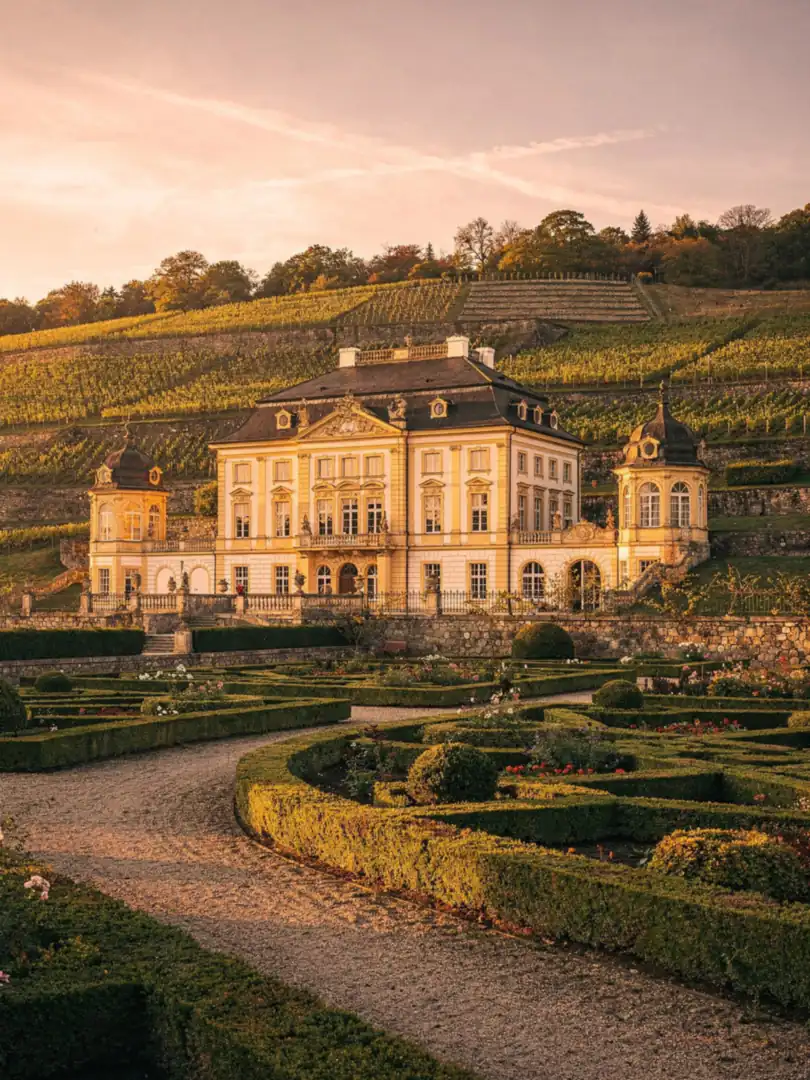
Anyone searching for Sekt from Saxony sooner or later ends up in Radebeul. On the northern edge of the Dresden Elbe Valley stands Schloss Wackerbarth, the Saxon State Winery with its own sparkling wine manufactory, surrounded by the vineyard terraces of the Lößnitz.
The Saxony wine region stretches roughly 55 kilometers from Pillnitz near Dresden through Radebeul and Meißen to Diesbar-Seußlitz. With about 500 hectares of vines, it is the third-smallest of Germany's 13 wine regions. Amid the vineyards stands the Hoflößnitz estate, an ensemble of press house, pleasure and hillside house, vintner's house and cavalier's house, which today houses a museum and a wine shop.
According to Schloss Wackerbarth, the estate's sparkling wine history dates back to 1836, when Saxony's first Sekt manufactory was founded in Radebeul. It was called Bussard. Later, the operation moved with its machinery and staff to the grounds of Schloss Wackerbarth, and in 2023 the Bussard Sekt brand got a new look. By 2026, the house counts 190 years of Sekt tradition by its own reckoning.
What does Sekt b.A. from Saxony mean? It's quality sparkling wine from the Saxony growing region that has been assigned an official testing number and is sold in a Sekt bottle with a mushroom-shaped cork and wire cage. A Winzersekt must, in addition, come from grapes grown on the producer's own estate, be traditionally bottle-fermented, and carry the grape variety and vintage on the label.
Schloss Wackerbarth bottles around 250,000 bottles of bottle-fermented Sekt per year, according to its own figures. That's a modest output for a Sekt house, and it fits a region where every slope has its own name. This sense of place sets such bottles apart from a plain Sekt whose base wines may also come from other EU countries.