Granite, Loess, Cool Air
Soil & Climate
Why does Sekt from the Elbe Valley taste so crisp? The region lies at around 51 degrees north latitude and is among Europe's northernmost wine regions. Grapes ripen more slowly there, and the wine retains the acidity that a Sekt base wine needs, since the dosage later balances some of it out.
In the Elbe Valley basin, the annual average temperature is 9.2 degrees Celsius, according to the state of Saxony. Rainfall ranges from 600 to 700 millimeters a year, and the sun shines for around 1,750 hours. The Elbe moderates temperatures along the riverbank, while the slopes catch the light.
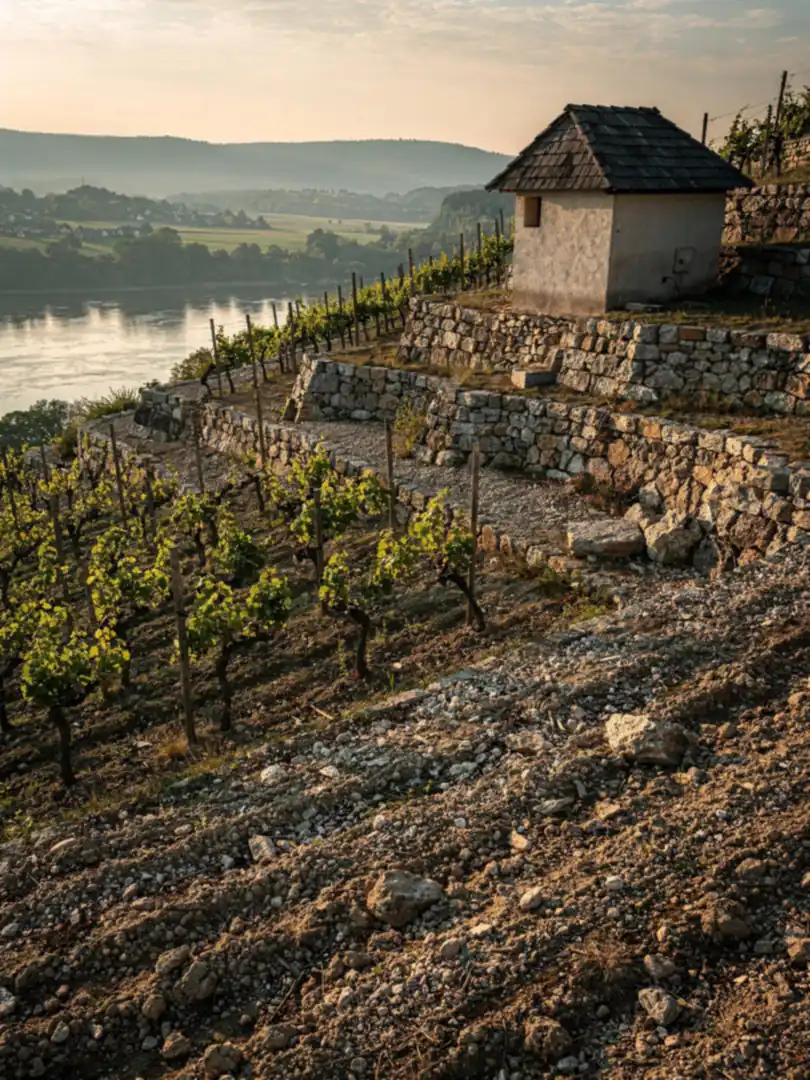
The soil consists of three types: weathered granite-syenite, loess loam, and sand. The loose, weathered granite and syenite soils in particular have little fine earth. Water drains through them quickly, forcing the roots to search for moisture. Loess loam, by contrast, holds more water.
Radebeul's vineyard sites carry names like Goldener Wagen, farmed by several winemakers, or Kapitelberg, one of Saxony's largest and finest sites at over 40 hectares. At the edge of the slope stand the Spitzhaus and the Bismarck Tower, landmarks above the vine rows.
For Sekt, what ultimately matters is what remains after the second fermentation. Because alcohol and carbon dioxide are added during this process, and sugar is dosed in at the end, the base wine needs a firm backbone of acidity. The label of a Sekt b.A. may state 'Steillage' (steep slope) if the grapes come from vineyards with at least a 30 percent gradient.