Time and Sugar
Lees Aging & Dosage
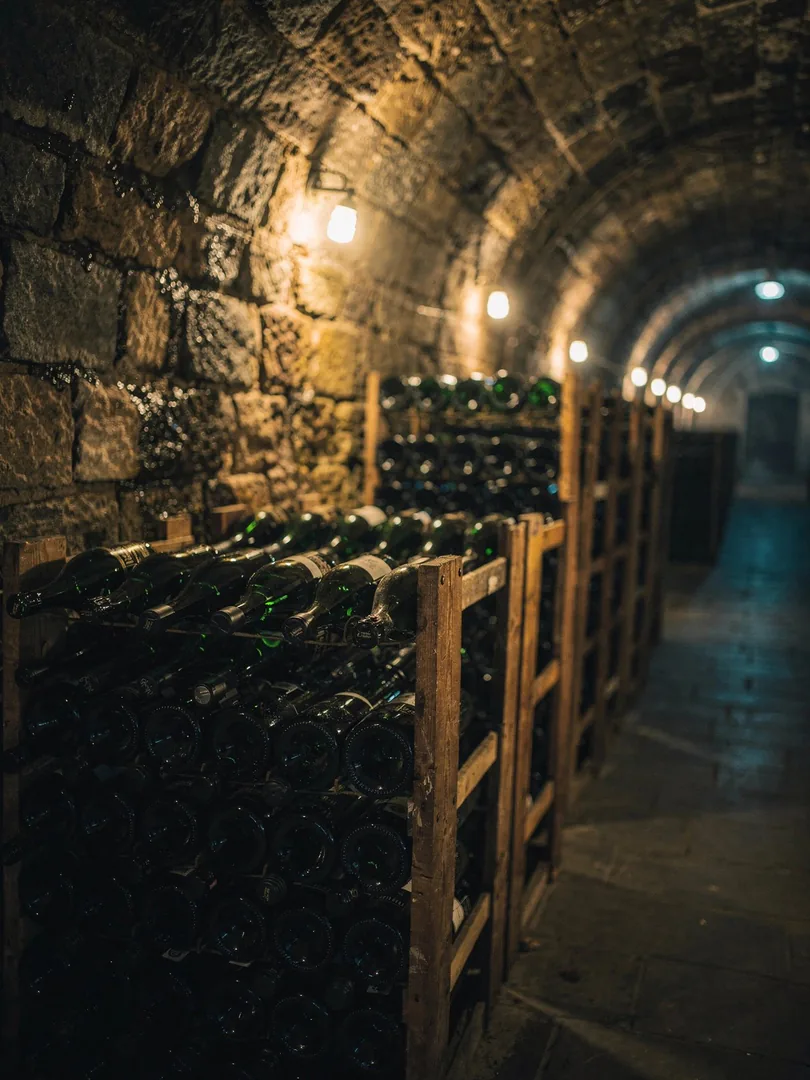
The law requires only nine months of lees aging for Winzersekt. One merchant lists 24 months for the Scharzhofberger Riesling Sekt from Bischöfliche Weingüter Trier, and Agritiushof likewise states a minimum of two years on the lees for its Riesling Crémant. The longer the wait, the greater the depth.
During this time, the yeast cells break down—a process called autolysis—which gives the sparkling wine aromas of bread, nuts and brioche, along with a creamier mouthfeel. In Riesling, this balances out youthful harshness without sacrificing acidity. The longer the yeast works, the finer and creamier the mousse appears in the glass. For Mosel sparkling wine, lees aging is therefore not a mandatory step but a choice made by the producer.
Afterward, the sparkling wine is riddled so the yeast settles into the neck of the bottle. During disgorgement, the neck is briefly frozen, the plug of yeast shoots out, and the bottle receives its dosage—a mixture of wine and sugar that fine-tunes the final taste.
Sweetness levels follow fixed categories. Brut Nature has less than 3 grams of sugar per liter, Extra Brut up to 6, Brut under 12, and Extra Dry between 12 and 17. For Sekt, 'trocken' (dry) then means 17 to 32 grams—more sugar than Brut.
With Riesling especially, it's worth asking about the sweetness level. A robust Mosel Riesling can carry more dosage than a gentler Chardonnay-based sparkling wine, because its acidity balances the sugar. The sweetness level is stated on the label, but reading 'trocken' doesn't mean you're getting the driest sparkling wine available.