Bottle or Tank
The Second Fermentation
At the Deinhard house in Koblenz, sparkling wine production began in 1843; today, at the Trier facilities of the Schloss Wachenheim group, it's produced on a large scale. Both represent two paths to the second fermentation: wine becomes sparkling wine either in the bottle or in a tank.
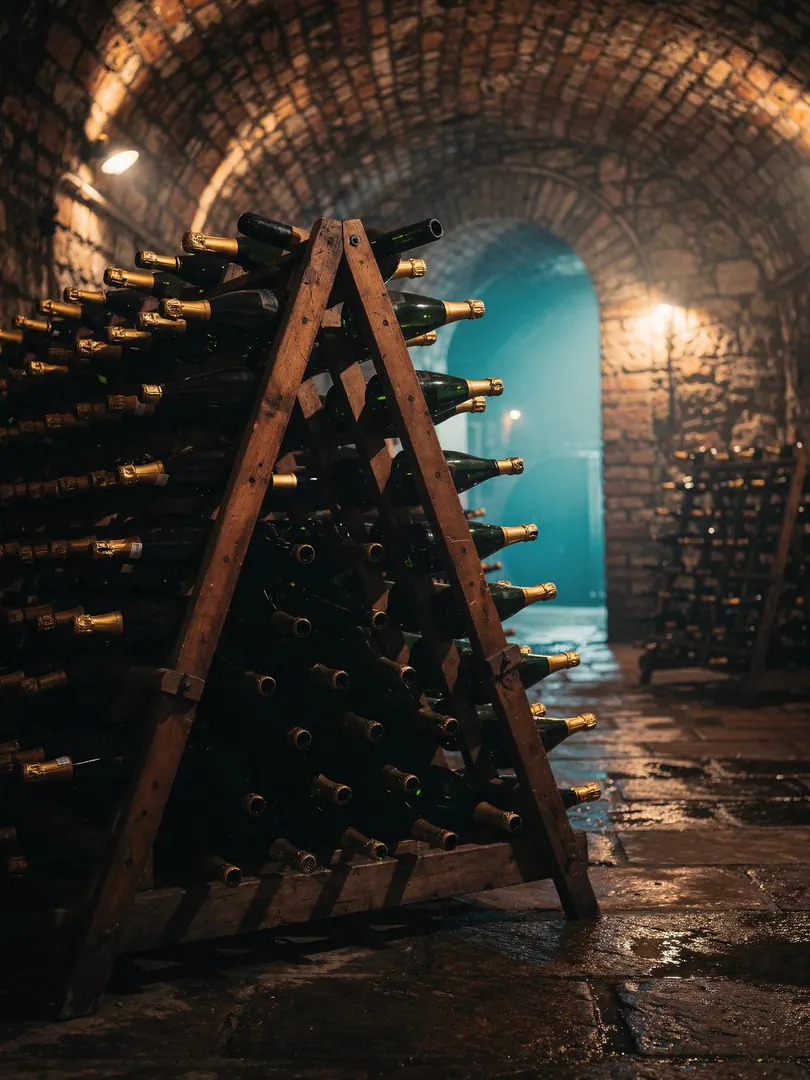
In bottle fermentation, yeast and sugar—the tirage dosage—are added to the base wine, and the bottle is sealed. Inside the bottle, the sugar ferments with the yeast into alcohol and carbon dioxide. The gas cannot escape and dissolves into the wine until the pressure reaches at least 3.5 bar.
The term 'traditionnelle' (traditional) is legally protected. Only a producer who ages the wine on the lees without interruption for nine months in the same winery and disgorges it from the very same bottle may label it 'traditional bottle fermentation.' Winzersekt requires exactly this. There's also the transfer method, in which the sparkling wine is transferred into a tank and filtered.
Major branded sparkling wines are usually made in tanks. There, just six months of production and 90 days on the lees suffice—or 30 days with a stirring device. This method is faster and cheaper, and the result tastes fresher but shows less bread and brioche character. For small producers, bottle fermentation means more work and more cellar space, since every bottle must be stored, riddled, and individually disgorged.
The Saar Mosel Winzersekt house in Konz, where the Saar flows into the Mosel, riddles its sparkling wine by hand, according to its own description. The profile below shows how three different approaches differ across the Mosel.
Mosel Sekt b.A. Bottle-FermentedBottle fermentation · Riesling
- Time on lees
- 9–24 Months
- Sugar
- 0–12 g/l
- Alcohol
- 11–12.5 % vol
Salty-mineral, yellow apple, pear, taut acidity from the slate.