Yeast, Riddling, Dosage
Lees Aging & Dosage
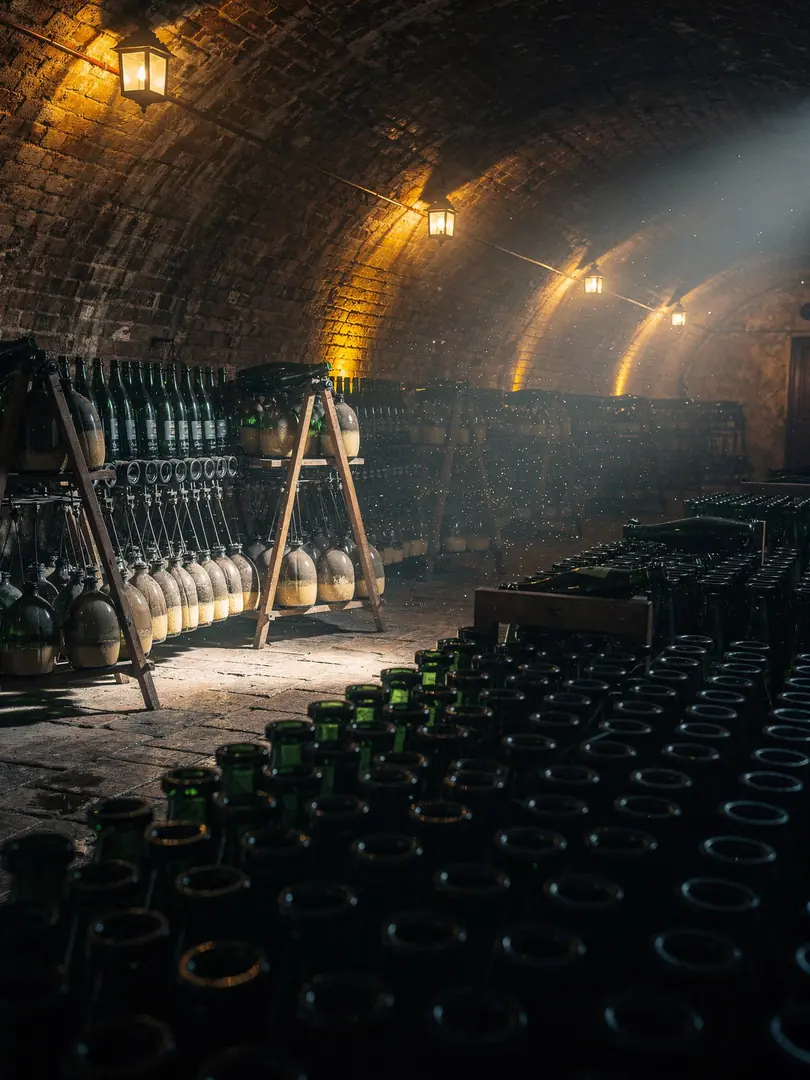
After fermentation, Sekt—whether made in Biebrich or elsewhere—rests on its lees. The yeast cells gradually die off and break down, a process called autolysis. In doing so, they release aromas of bread, nuts and brioche, and make the Sekt feel softer on the palate. The longer the aging, the more pronounced this becomes.
The law sets minimum durations. Tank-fermented Sekt requires six months of production, bottle-fermented Sekt nine months. A short stint in the tank yields little yeast character, keeping the fruit in the foreground instead. A "traditional bottle fermentation" must rest continuously on the lees for at least nine months within the same producer's facility.
Eventually, the yeast must be removed. In the classic method, the bottles are riddled—once by hand on a riddling rack, now usually by machine—until the sediment collects in the neck of the bottle. During disgorgement, the neck is frozen in a brine solution at around minus 20 degrees, the crown cap is opened, and the plug of yeast sediment shoots out. In tank production, a filter handles this step instead.
Finally comes the dosage, the liqueur d'expédition. This is sugar dissolved in wine, which determines the final taste. It may raise the alcohol content by no more than 0.5 percent ABV. For Sekt, this dosage is mandatory, since the sugar level must be stated on the label.
The levels are precisely defined: Brut Nature has under 3 grams of sugar per liter, Extra Brut 0 to 6, Brut under 12, Extra Dry 12 to 17, Trocken 17 to 32, Halbtrocken 32 to 50, and Mild over 50. Extra Dry is therefore sweeter than Brut. Likewise, "Trocken" in Sekt means more sugar than Brut, and "lieblich" doesn't exist as a category for sparkling wine at all. The name Henkell Trocken dates back to 1894; which sweetness level a bottle carries today is shown only on its label.