Twelve Months on the Lees
Lees Ageing & Dosage
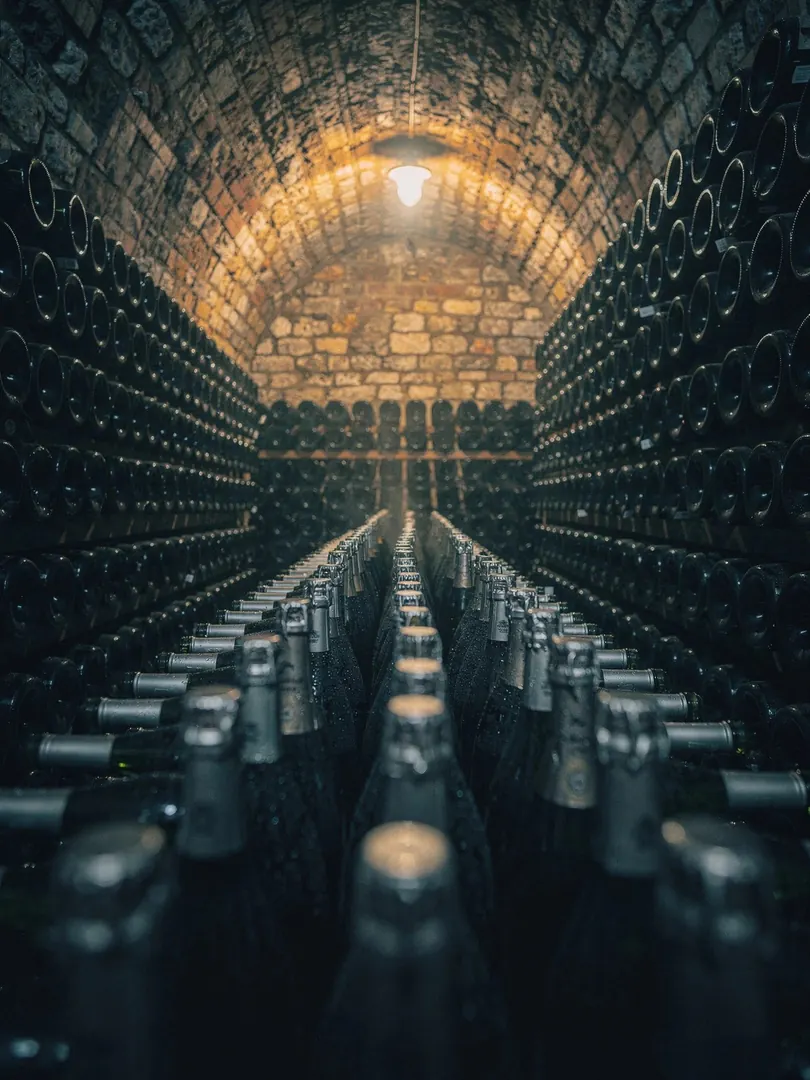
Sparkling wine under the Sussex PDO rests on the lees for at least twelve months, with at least fifteen months in bottle overall before it can be sold. Many houses wait considerably longer. Nyetimber leaves its Classic Cuvée for over three years, and its Blanc de Blancs, according to the house, for around five years, followed by a further 18 months under cork.
During this time, the dead yeast cells slowly break down. This process is called autolysis, and it gives the wine aromas of brioche, toast and nuts, along with a creamier mousse. The longer the yeast works, the more the fruit recedes and the broader the aroma becomes.
For the wine to turn clear, the yeast must eventually be removed. The bottles are gradually turned and tilted upright until the sediment collects in the neck. During disgorgement, the cellar master opens the bottle, and the yeast plug shoots out under pressure. The bottle is then sealed with a natural cork and wire cage.
Now the wine still needs balancing. The dosage, a dash of sugar solution, rounds off the high acidity, which is especially pronounced in England. The level appears on the label: Brut Nature under 3 grams per litre, Extra Brut up to 6, Brut under 12, Extra Dry 12 to 17, and Demi-Sec 32 to 50.
Brut is the level you see most often on English bottles. With high acidity, a touch more sugar can be used without the wine tasting sweet. Nyetimber also bottles its Cuvée Chérie as a Demi-Sec, named after head winemaker Cherie Spriggs. Extra Dry, incidentally, is sweeter than Brut, not drier.