Years on the lees
Lees Aging & Dosage
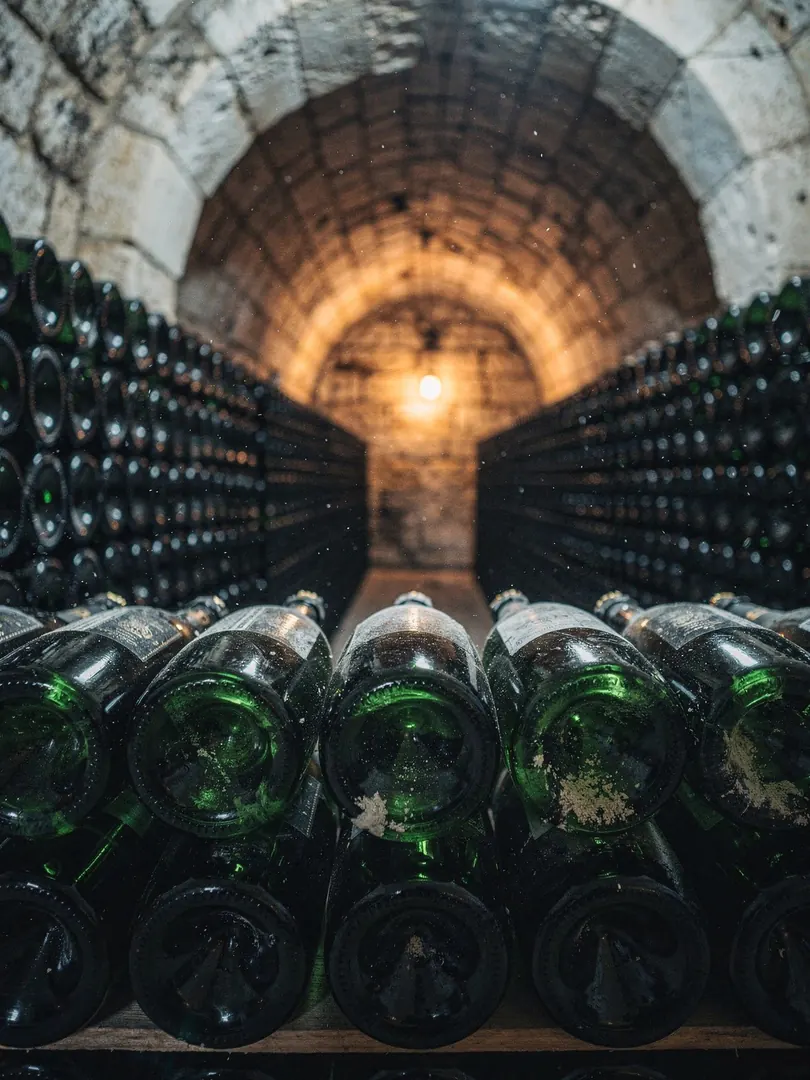
Champagne must rest uninterrupted on the lees for at least twelve months before it may be disgorged. For non-vintage champagne, at least 15 months must pass from tirage to sale; for vintage champagne, 36 months. Many houses voluntarily let their bottles age far longer.
The yeast cells die off and break down. This autolysis releases aromas of brioche, bread, and nuts, and rounds out the wine on the palate. The longer the bottles rest, the more the fresh fruit character recedes.
Devaux states its house standard as five years of aging for the Collection D and ten years for the vintage wines. That goes well beyond the legal minimum and reflects the logic of a cooperative that first had to build its name in the market.
After that, the lees must come out of the bottleneck. During riddling, the bottles are gently turned and gradually tilted to a steeper angle, day by day over several weeks, until the sediment settles in the neck. Today, this is mostly handled by riddling machines, the gyropalettes.
During disgorgement, the bottleneck is dipped into a brine solution at minus 20 degrees Celsius. The plug of frozen lees forms, the crown cap is removed, and the pressure shoots the frozen plug out. The cellar master then adds the dosage, the liqueur d'expédition, a mixture of sugar and wine.
This determines the sweetness level: Brut Nature has under 3 grams of sugar per liter, Extra Brut 0 to 6, Brut under 12. Anyone assuming Extra Dry is the drier style is mistaken: at 12 to 17 grams, it's actually sweeter than Brut. Fleury produces a Brut Nature, while Drappier, according to the house, works with very low sulfur levels at bottling.