Bottle, never tank
The Second Fermentation
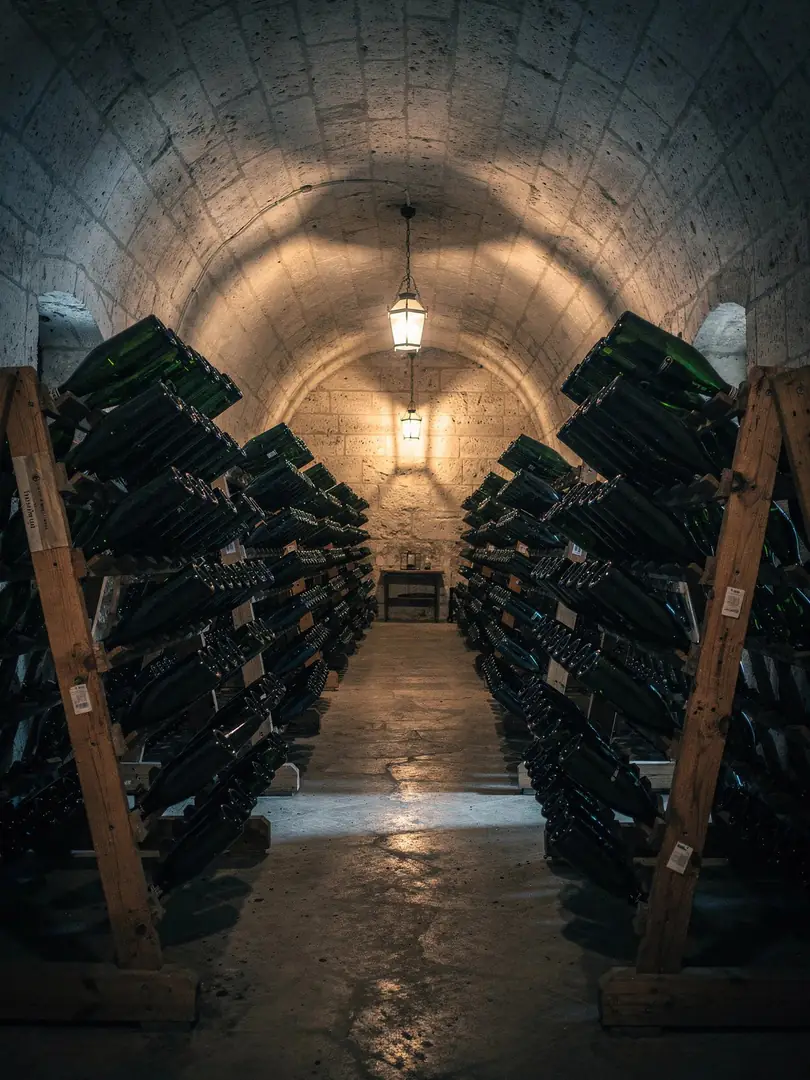
How does bottle fermentation work in champagne? The finished base wine is bottled with sugar and yeast, the liqueur de tirage, and sealed with a crown cap. Inside the sealed bottle, the second fermentation begins, and the resulting carbon dioxide has nowhere to escape.
This bottling, the tirage, may not begin in Champagne before January 1st following the harvest. Guideline figures cite around 24 grams of sugar per liter and 20 grams of yeast per hectoliter. In the Côte des Bar too, the rule holds that the second fermentation takes place exclusively in glass bottles.
This rules out tank fermentation for champagne entirely, along with any of the shortcuts familiar from Prosecco country. Twelve months of lees aging is the bare minimum; disgorgement, which follows only after that, marks the next stage.
Fermenting bottles rest in the cellar at around 13 degrees Celsius. By the end, pressure in the glass reaches about six bar at 20 degrees. The legal minimum for quality sparkling wine is 3.5 bar, so champagne sits well above that threshold.
Format is regulated too. Champagne stays in the bottle in which it fermented. Only piccolo bottles under 37.5 cl and formats of 150 cl and larger may be transferred after fermentation. Drappier in Urville ages its large formats in the old monastery cellars.
The Union Auboise cooperative bottles for its growers under the Devaux name, while small family producers like Fleury in Courteron do it themselves. The process is the same everywhere; only the size of the cellars and the timeline differ.
Champagne Blanc de Noirs BrutBottle fermentation · Pinot Noir
- Time on lees
- 15–36 Months
- Sugar
- 0–12 g/l
- Alcohol
- 12–12.5 % vol
Red cherry and strawberry, brioche, lean body, crisp acidity.