Years on the Lees
Lees Aging & Dosage
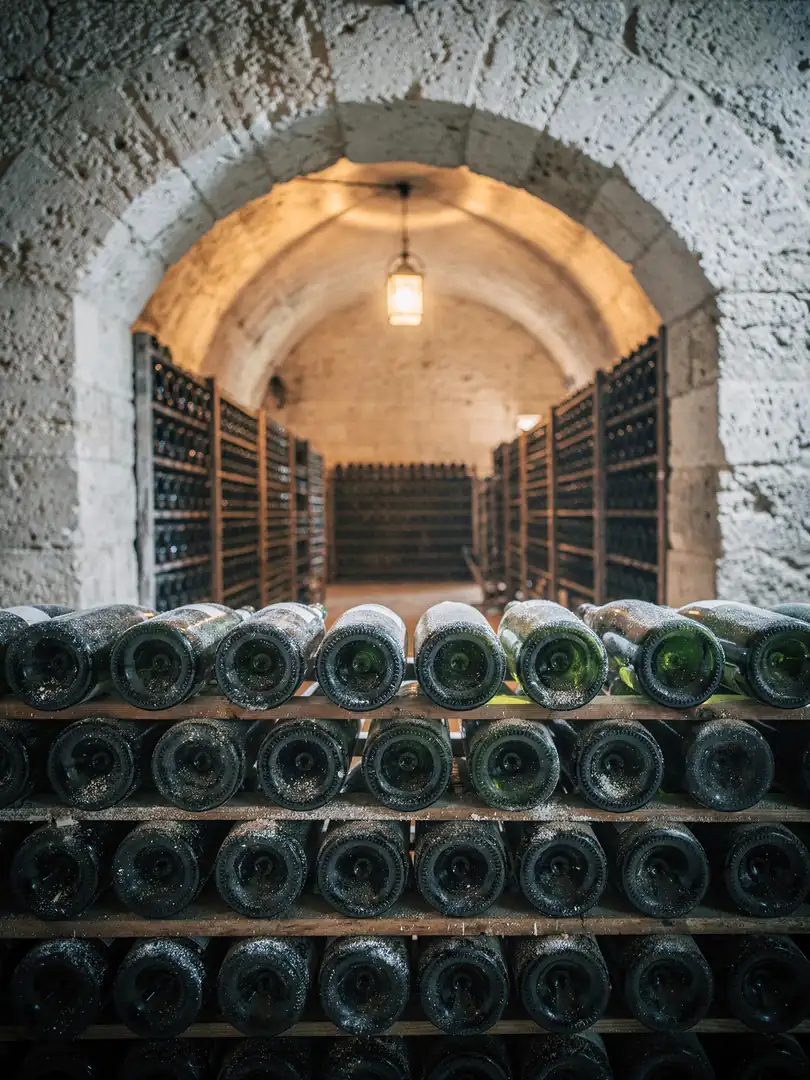
After fermentation, the bottles rest. Appellation rules require non-vintage Champagne to age at least 15 months from tirage, with at least 12 uninterrupted months on the lees; vintage Champagne requires 36 months. Many producers age their wines voluntarily for much longer.
The yeast cells die and break down. This process is called autolysis, releasing aromas of brioche, bread, and nuts while also making the wine creamier on the palate. In a Chardonnay from the Côte des Blancs, which is austere and citrusy in its youth, this acts as a counterweight.
The first Clos du Mesnil, from the 1979 vintage, was introduced in 1986, seven years after the harvest. Salon, too, leaves its vintages in the cellar for a long time before releasing them.
In the end, the yeast settles as sediment in the bottle. To move it into the neck, the bottles rest on riddling racks, tilted with the neck pointing downward, and are turned slightly and tilted more steeply each day over several weeks. Today this is often done by machines called gyropalettes.
During disgorgement, the bottle neck is dipped into a freezing solution at around minus 20 degrees Celsius. The yeast plug freezes, the crown cap is removed, and the pressure shoots the plug out.
The missing wine is topped up with the dosage, the liqueur d'expédition made of sugar dissolved in wine. This determines the sweetness level: Brut Nature has less than 3 grams of sugar per liter, Extra Brut up to 6, Brut under 12. Extra Dry, at 12 to 17 grams, is actually sweeter than Brut, despite its name. Given the taut acidity of a Blanc de Blancs, some producers choose a very low dosage.