Yeast and Sugar
Lees Aging & Dosage
Four months is the minimum. That's how long sweet Clairette de Die must rest on its lees in the bottle before it can be sold, and no earlier than March 1st following the harvest. Compared to Champagne, which requires at least 15 months from tirage, this is a short aging period—fitting for a wine meant to taste of grape, not of brioche.
Yeast autolysis refers to the breakdown of dead yeast cells, which over time gives wine notes of bread crust, nuttiness, and pastry. After just four months, little of this can be expected. Dry Clairette de Die must rest on its lees for at least nine months, as required by the regulations; for Crémant de Die, the EU minimum of nine months applies.
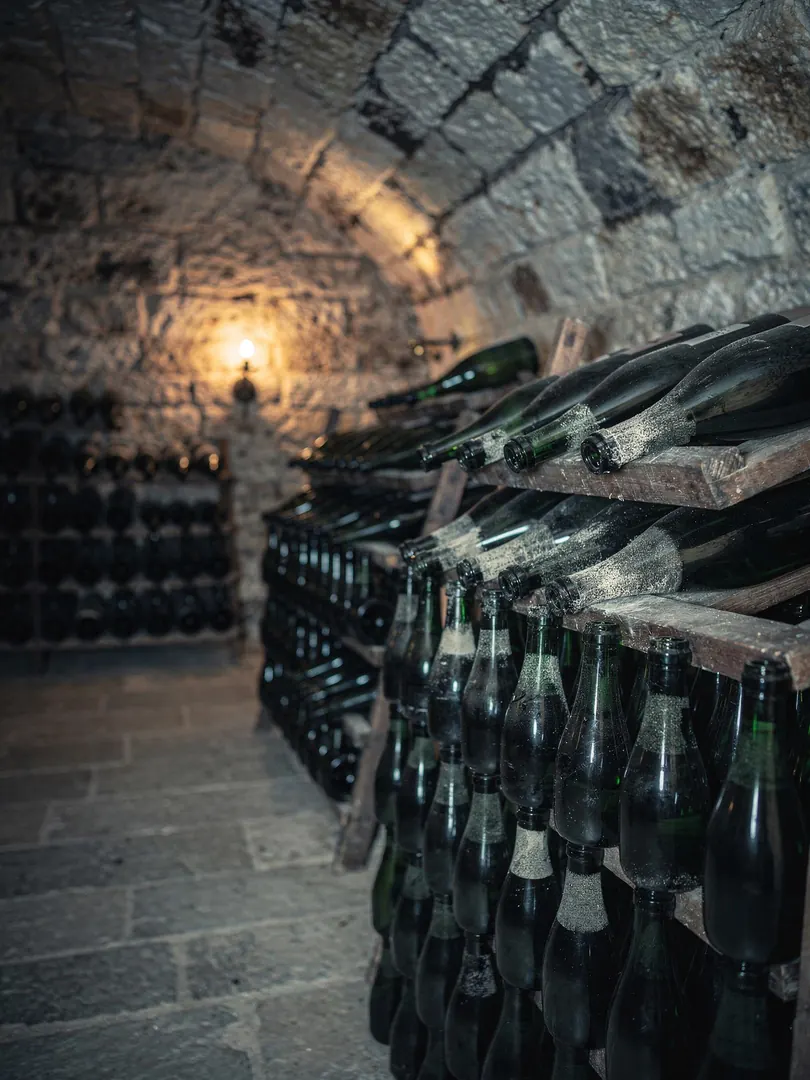
Riddling means tilting the bottles and turning them regularly so the yeast settles into the neck. The regulations don't specify whether producers in the Diois must do this by hand or by machine. The same applies to disgorgement: the regulations list it merely as one of three permitted ways to remove the lees.
Dosage—the addition of sugar just before corking—is entirely absent in the sweet style. A liqueur d'expédition is explicitly forbidden; the sweetness comes solely from the residual grape sugar the yeast failed to ferment. At least 35 grams of fermentable sugar per liter must remain in the wine, with around 50 grams per liter commonly cited.
It's different for dry Clairette de Die: after the dosage d'expédition, no more than 15 grams of sugar per liter may remain in the wine. This covers the Brut category (under 12 grams) and the beginning of Extra Dry (12 to 17 grams). For Crémant de Die, sugar content must stay under 50 grams per liter, as with any Crémant.