Laths, lees, dosage
Lees Aging & Dosage
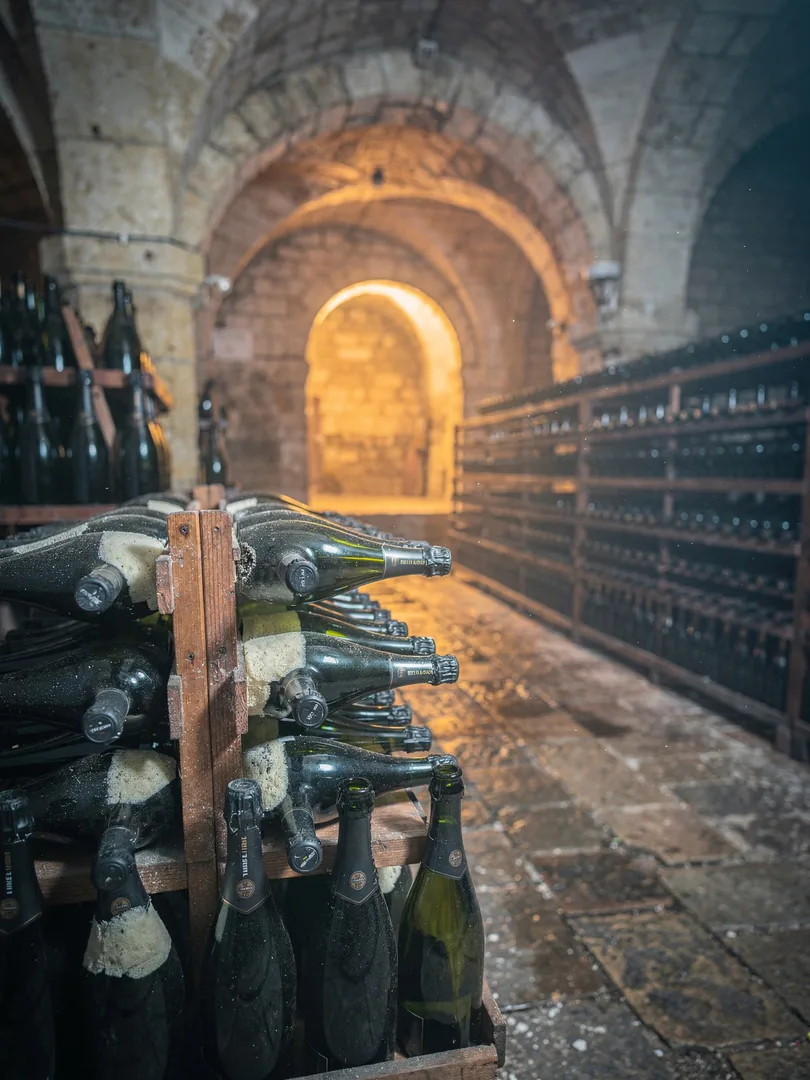
After the tirage, the bottles go into the cellar lying flat on laths. The Jura specification explicitly speaks of the long stay “on laths” that the specialists around Arbois favor. Here it is cool and quiet all year round, and only gravity and time do the work.
The bottles must rest on the lees for at least nine months. A Crémant du Jura may reach the market no earlier than twelve months after the tirage. Waiting longer brings more depth, but the specification sets only the minimum here.
During this time the yeast dies and releases compounds into the wine. This process is called autolysis. It gives brioche, nuts and a creamy mousse. For white Jura crémant, the specification names notes of apple, brioche and hazelnut, and for the rosé, red berries.
After that, the yeast has to leave the bottle. It is riddled until it collects in the neck, by hand on a riddling rack or in a machine. The turning movement nudges the sediment down bit by bit. Finally the wine is disgorged: the bottle is opened briefly, the pressure expels the yeast, and a little wine flows in to replace it.
The dosage rounds off the wine: a splash of wine with a little sugar. Up to 12 grams per liter the wine is called Brut, up to 6 grams Extra Brut, and under 3 grams Brut Nature. The dosage may raise the alcohol by no more than 0.5% ABV.
For Crémant de Savoie, the appellation specifies at least twelve months of maturation, and for Seyssel mousseux nine months on the lees.