Bottle, not tank
The Second Fermentation
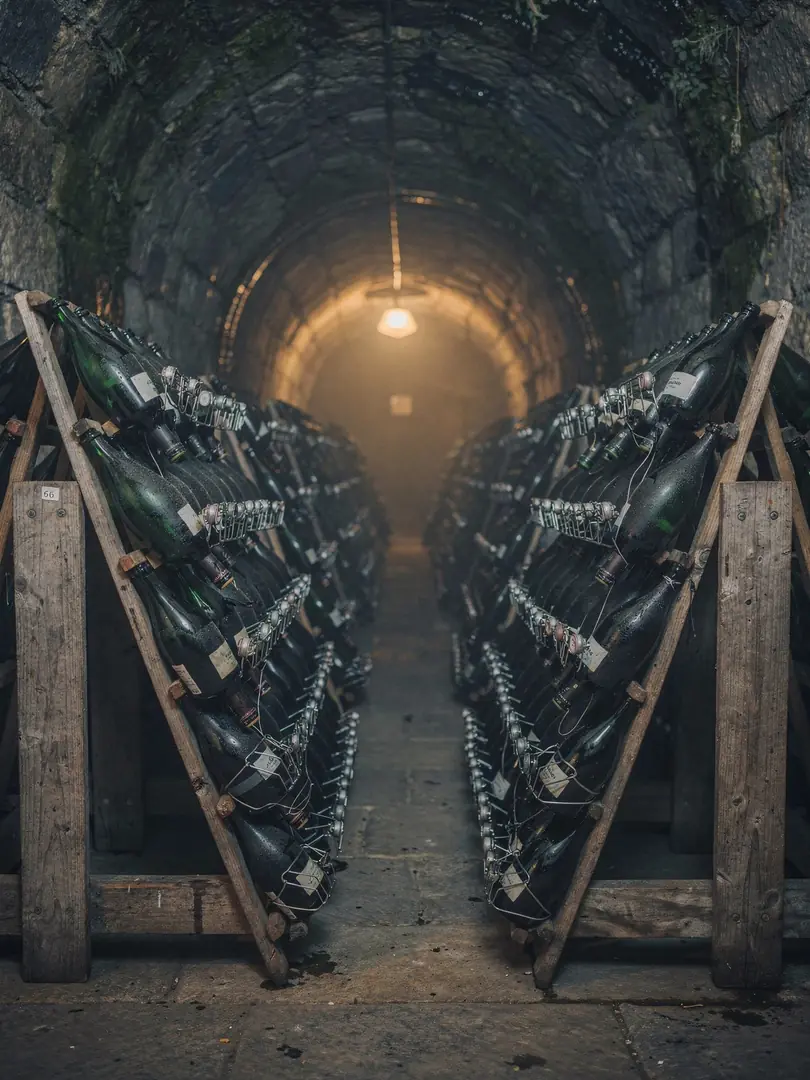
Crémant du Jura may only be made through a second fermentation in the glass bottle. Tank fermentation, transfer and the addition of carbon dioxide are thereby excluded. In the cellars of Arbois, too, the yeast works in the very same vessel in which the wine is later bought.
Filling the bottles for fermentation is called the tirage. In the Jura, it may begin no earlier than 1 December after the harvest. For this, the cellar master adds sugar and yeast to the base wine, the liqueur de tirage. The yeast ferments the sugar into alcohol and carbon dioxide, which cannot escape from the sealed bottle.
The carbon dioxide builds up pressure. After disgorgement, the specification requires at least 3.5 atmospheres at 20 degrees. A cork alone would not withstand this pressure, so it is secured by a wire cage, the agrafe.
The order of steps matters. First the base wine is made in the ordinary way as a still wine, and only then comes the second fermentation. For this, the bottle is sealed with a crown cap and waits in the cool cellar. The slow, cool work of the yeast helps the mousse, because carbon dioxide dissolves particularly finely in the wine under these conditions.
In Savoy, the same principle applies to Crémant de Savoie: traditional bottle fermentation, hand harvesting, and at most 100 liters of must from 150 kilograms of grapes. The wines must spend at least nine months on the lees; according to the appellation, they mature for twelve months in total.
How a house works is stated on the label. Méthode traditionnelle means a second fermentation in the bottle with disgorgement. With the méthode ancestrale, by contrast, a single, interrupted fermentation finishes in the bottle. Seyssel mousseux is also made in the bottle, with at least nine months on the lees.
Crémant du Jura BrutBottle fermentation · Chardonnay, Pinot noir, Trousseau, Poulsard, Savagnin
- Time on lees
- 9–18 Months
- Sugar
- 0–12 g/l
- Alcohol
- 12–12.5 % vol
Delicate and fine, apple and hazelnut, fresh acidity, red berries in the rosé.