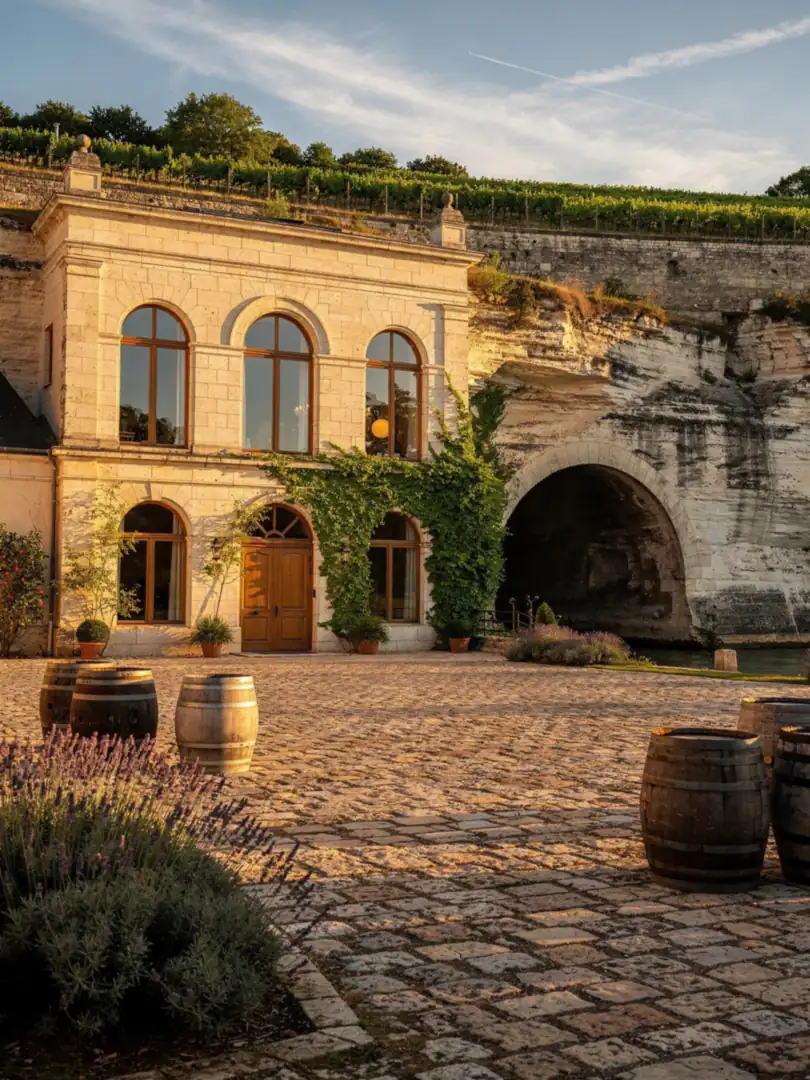
Quarry Becomes Cellar
Region & History
What a Crémant de Loire actually is becomes clear in Saumur, right in the middle of the Loire Valley between Angers and Tours. The name stands for sparkling wine made by bottle fermentation across Anjou, Touraine and Saumur, yet a large part of its history unfolds beneath the slopes of this one town.
It all began with quarries. For centuries, the pale tuffeau stone here was cut to build the valley's châteaux, leaving behind miles of galleries carved into the hillside. Ackerman, founded in 1811 according to the house, is considered the oldest sparkling wine producer on the Loire. In 1851, Étienne Bouvet established his cellar in Saint-Hilaire-Saint-Florent and added his wife's name, Ladubay. Alfred Gratien followed in 1864, taking over, by his house's account, nearly ten kilometers of old quarry galleries, and ten years later brought in Albert Jean Meyer from Alsace as a partner.
Today two appellations carry this tradition forward. Saumur brut has been its own AOC since 1957, with vineyards concentrated mainly south of the town. Crémant de Loire followed in the 1970s and covers a much larger area. Both require hand-harvesting and traditional bottle fermentation, where the wine matures and develops its bubbles in the very same bottle.
France recognizes eight such Crémant appellations, and the regional name always comes attached: whenever you see Crémant on a label, the region follows right after—here, 'de Loire.' This also answers the first question people ask about how Crémant differs from Champagne: it's about where the grapes grow, not the method used to make the wine.
The great houses still age their bottles in these rock walls today. Visitors descend first, then realize that the vineyard above is, in a sense, growing on the roof of an enormous underground warehouse.