Time on the Lees
Lees Aging & Dosage
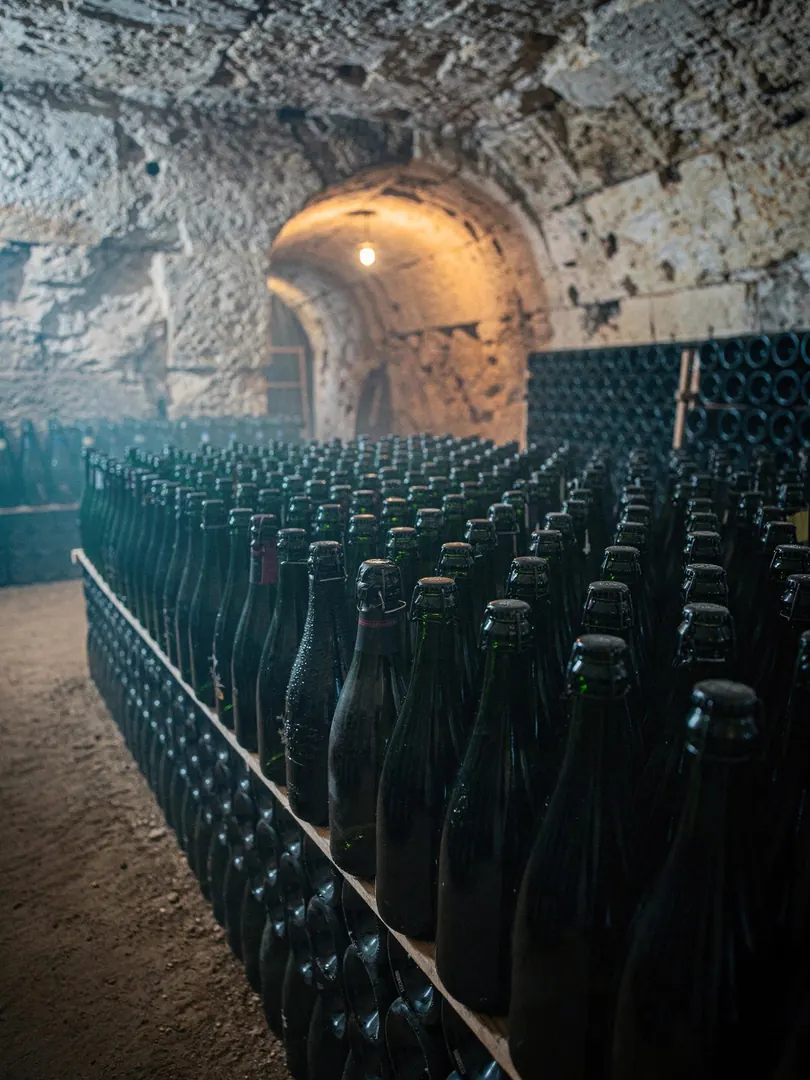
How long does Crémant de Loire rest on the lees? Appellation rules require at least twelve months, while Saumur brut needs at least nine. Longer aging is always allowed, and the cellars built into the hillside happily take advantage of it, since space and cool air are never in short supply.
During this time, dead yeast cells slowly break down and release proteins and amino acids into the wine. This process, called yeast autolysis, brings notes of bread crust and brioche. In Chenin, hazelnut and a hint of honey emerge as well, and the bubbles grow creamier.
After that, the lees have to come out of the bottle. The bottles are placed neck-down at an angle on riddling racks or in large gyropalettes, where they're regularly turned and gradually tilted further, until the sediment collects in the neck.
During disgorgement, the neck is chilled in a bath so the yeast sediment freezes into a solid plug. When the bottle is opened, the built-up pressure shoots the plug out, leaving the wine behind perfectly clear. The small amount of wine lost is topped up with the dosage, a mixture of wine and sugar that defines the house's final style.
Brut means fewer than twelve grams of sugar per liter, Extra Dry falls between twelve and seventeen grams and is therefore sweeter than Brut. For Crémant, the limit stays below fifty grams. A Crémant de Loire demi-sec with 32 to 50 grams does exist and is a popular pairing with dessert in the region.
Chenin can handle a bit more sugar than many other grapes, since its acidity supports it. Still, most houses keep the dosage fairly low, so the fruit and yeast character aren't masked.