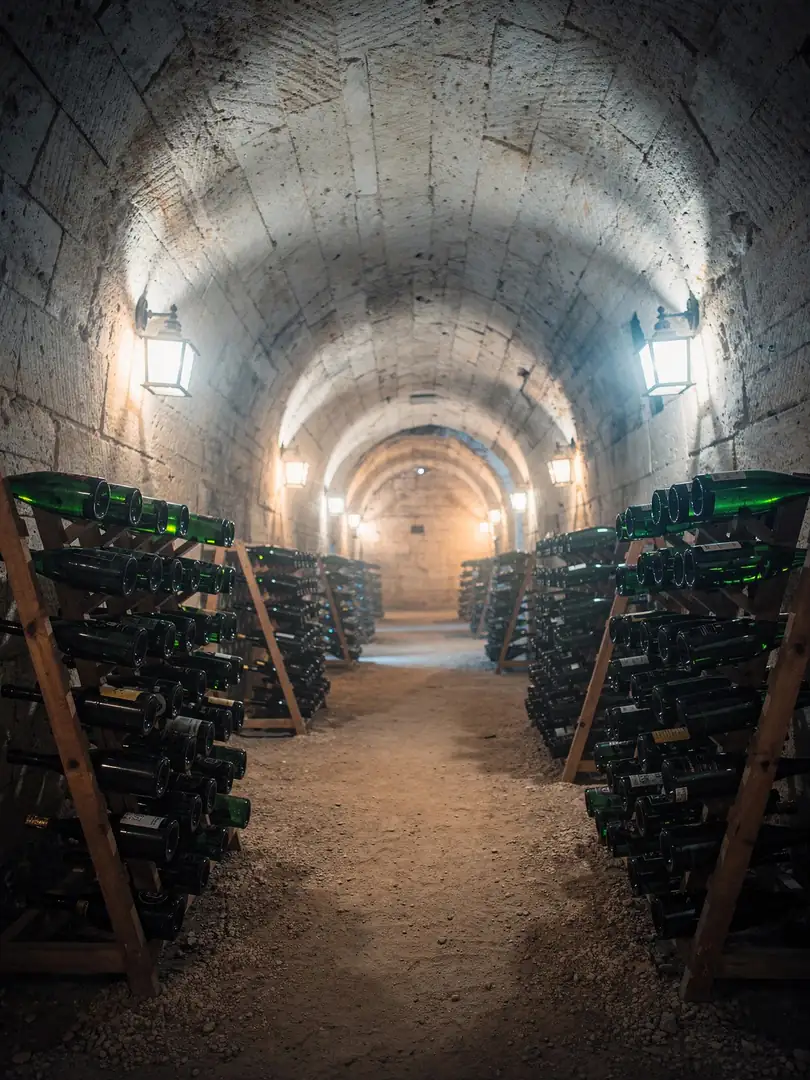
Fermentation in the Rock
The Second Fermentation
Bottle fermentation is what transforms the still base wine into a Crémant, and in the tuffeau cellar it begins with the tirage. A mixture of sugar and yeast, the liqueur de tirage, is added to the finished wine, which then goes into thick bottles sealed with a crown cap.
Inside the sealed bottle, the yeast ferments the sugar. The resulting carbon dioxide has nowhere to escape and dissolves into the wine, building the pressure that will later form the bubbles. Regulations for quality sparkling wine require at least 3.5 bar, a threshold both Crémant de Loire and Saumur brut must meet.
This process is mandated in its traditional form. Tank fermentation is ruled out, as is the transfer method, where the bottle's contents are poured into a tank and filtered. The bottle in which the wine develops its sparkle must be the very same one from which the lees are later removed. The label may therefore state traditional bottle fermentation, but never the Champagne method.
The bottles first rest horizontally on wooden slats, lined up in long rows through the tuffeau galleries. The cool rock air slows fermentation, and according to common cellar wisdom, slow fermentation produces finer bubbles than a rushed one. After a few weeks the sugar is used up, converted into alcohol and pressure.
The profile here highlights the two flagship wines. Crémant de Loire comes from a broad area, while Saumur brut is sourced mainly from south of the town; both follow the same basic principle with slightly different blends and aging times.
A single fermentation followed directly by sealing, as with Pét-Nat, is a different matter entirely. It doesn't fall under either of these two appellations, even though such wines do exist along the Loire.
Crémant de LoireBottle fermentation · Chenin, Chardonnay, Cabernet franc, Pineau d'Aunis
- Time on lees
- 12–24 Months
- Sugar
- 6–12 g/l
- Alcohol
- 12–12.5 % vol
Apple, quince and hazelnut, crisp acidity, fine and creamy bubbles.