A year on the lees
Lees Aging & Dosage
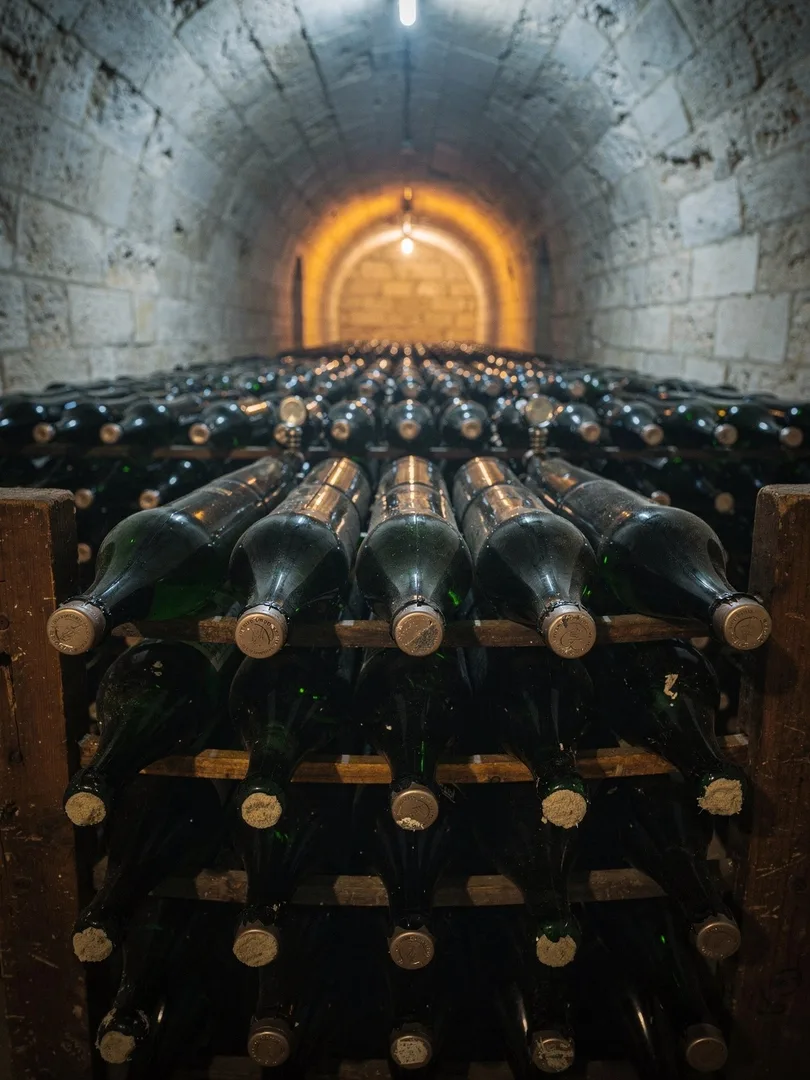
In the cellars of Vouvray, bottles lie sur lattes, stacked horizontally on wooden slats, with the lees settling along the bottle wall. Vouvray mousseux requires a minimum of one year of aging. How long a given house actually lets the wine rest is down to the cellar master.
During this time, the dead yeast cells break down and release their components into the wine, a process known as autolysis. It brings notes of brioche, almond and fresh bread, and rounds out the wine on the palate. The longer it rests, the finer the bubbles become and the less prominent the acidity feels. In Chenin, these notes merge with quince and honey, softening the high acidity just a touch.
Eventually, the lees have to come out. The bottles are riddled until the sediment settles in the neck, then the neck is frozen and the crown cap removed. The frozen plug shoots out on its own. Montlouis also requires this disgorgement for Pétillant Originel, though not before nine months have passed.
Then comes the dosage, a splash of wine with dissolved sugar added in tiny amounts to balance out the acidity. Vouvray produces sparkling wine both as a Brut, with under 12 grams of sugar per liter, and as a Demi-sec, with 32 to 50 grams. Chenin carries so much acidity that even a wine with over 30 grams of sugar doesn't taste cloying, but supple instead.
Montlouis's Pétillant Originel receives no dosage at all. Its residual sugar stays under five grams per liter and comes solely from the grape. As a result, it tastes dry, with no adjustment whatsoever, and often comes across more austere and primal than a dosed mousseux. Taste it for the first time, and you'll quickly notice that here, only the fruit and the yeast get to speak.