Two paths
The Second Fermentation
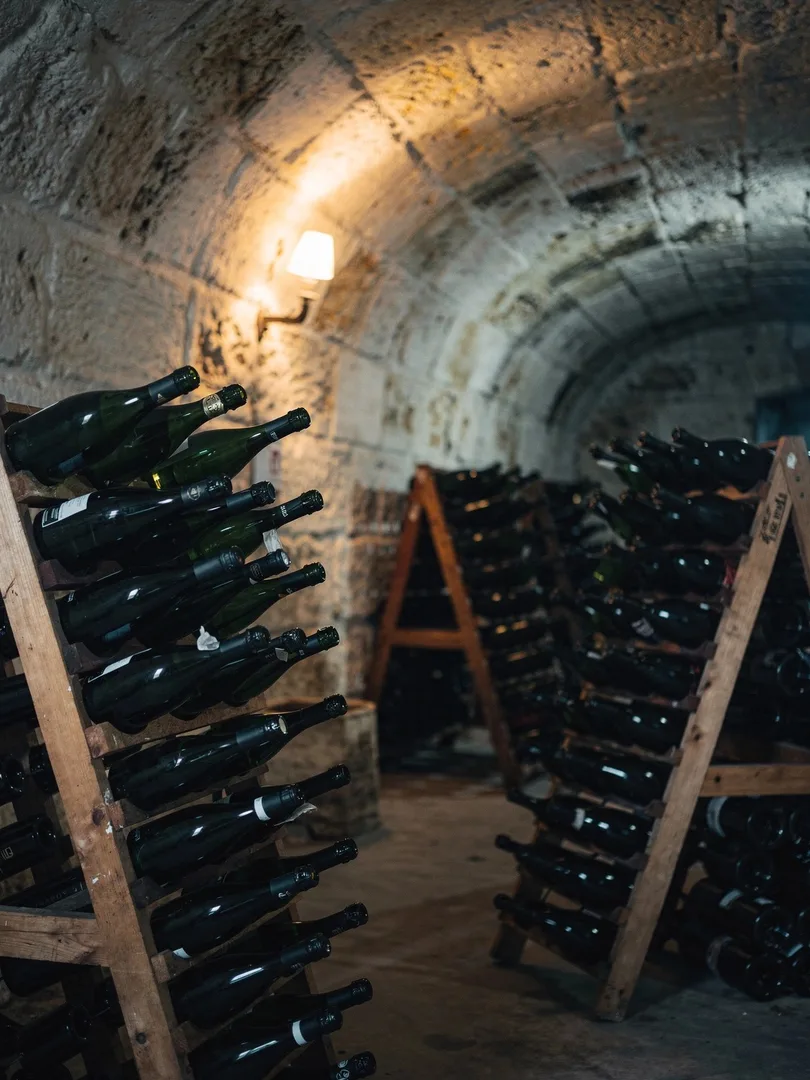
How does the fizz get into Vouvray? For mousseux, the method mirrors Champagne: the base wine goes into the bottle with a touch of sugar and yeast, sealed with a crown cap, and the second fermentation begins in the cellar. The appellation mandates this fermentation take place in the bottle.
Pressure is what makes the difference. Vouvray pétillant stays below 2.5 bar, while Vouvray mousseux ranges between 3 and 6 bar. Legally, that makes the first a semi-sparkling wine and the second a full sparkling wine. The pétillant prickles gently on the tongue, while the mousseux foams up vigorously and holds its bubbles longer.
Montlouis's Pétillant Originel takes the other path entirely. There's only a single fermentation, which finishes off in the bottle without any added sugar. This is the méthode ancestrale, the method of the ancestors. Known today by the shorthand Pét-Nat, it appears on the lists of many natural wine bars.
The term Pét-Nat has no legal protection and carries no EU definition of its own. Montlouis, however, has written the method into its rulebook: Chenin only, hand harvesting, no added yeasts or enzymes, no dosage liqueur and no liqueur d'expédition, and less than five grams of residual sugar per liter. Bottling can happen no earlier than 1 October of the harvest year.
The sugar in Pét-Nat comes entirely from the grape. The winemaker leaves just enough unfermented sugar behind so that enough fermentation remains to build up carbonation in the bottle. Too much residual sugar would create excess pressure, too little would leave a still wine.
The term Pétillant Originel belongs solely to this appellation. Elsewhere, any winemaker can produce a Pét-Nat without any origin rule, and depending on the pressure, it falls under the law for either semi-sparkling or fully sparkling wine. In Montlouis, it's a protected style that earns its own name on the shelf.
Vouvray Mousseux BrutBottle fermentation · Chenin blanc (Arbois as a minor variety)
- Time on lees
- 12–24 Months
- Sugar
- 0–12 g/l
- Alcohol
- 11.5–12.5 % vol
Quince, apple and brioche, fine bubbles, taut Chenin acidity.