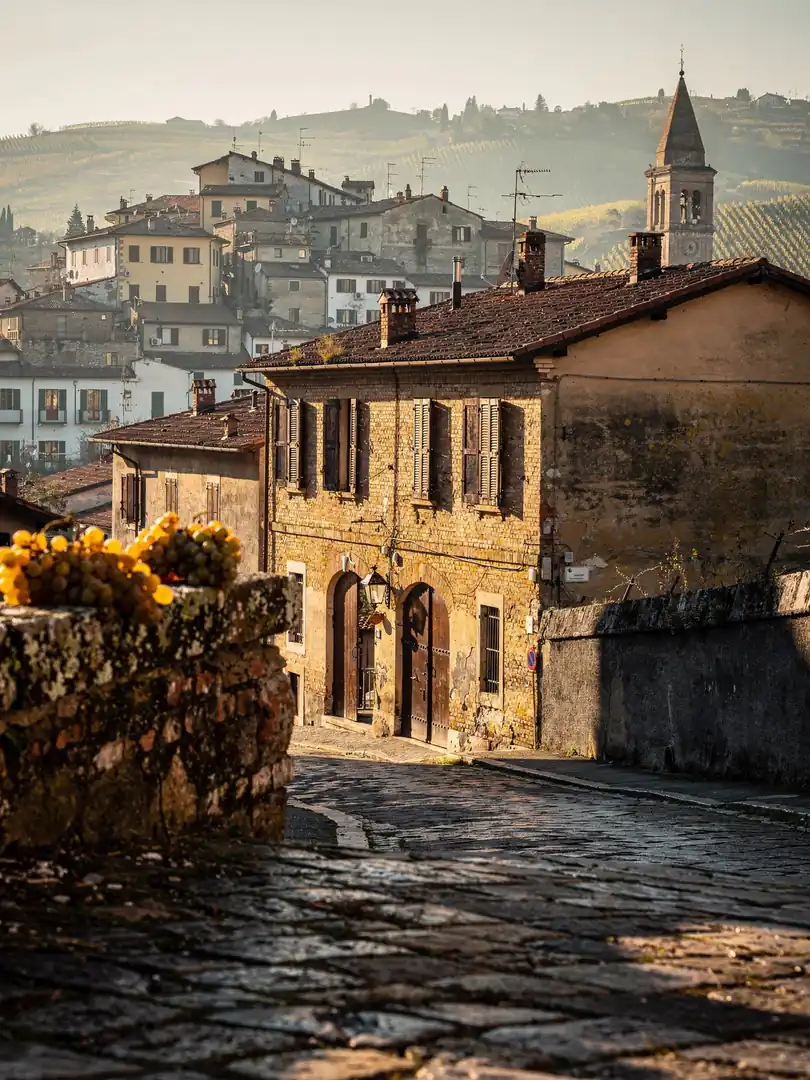
Canelli on the Belbo
Region & History
Asti Spumante is the sweet, grape-scented sparkling wine from southern Piedmont, and its heart beats in Canelli, a small town in the valley of the Belbo river. The name comes from the provincial capital Asti, yet the great houses are based in Canelli. The wine is defined by a single grape, Moscato bianco.
In the 19th century, the farmers' muscat wine became a sparkling wine for the cities. Carlo Gancia is considered the pioneer; he is said to have trained in Champagne and, around 1870, made the first sparkling wines from Moscato in Canelli. Bosca and Contratto, present in the town since 1831 and 1867 respectively according to their own accounts, expanded their cellars. All three names still exist today.
A leap forward came in 1895 from Federico Martinotti at the oenological research institute in Asti. He had a process patented in which the wine no longer foams in individual bottles but in a large, sealed pressure tank. The Frenchman Eugène Charmat improved the technique and patented it in 1907. In Italy, it is therefore still called the Metodo Martinotti to this day.
Producers organized themselves early on. In 1932, the growing area was first delimited with 45 municipalities, and in the same year a consortium was founded to protect the designation of origin. Since 1993, the wine has carried the DOCG, Italy's highest designation of origin. It applies to both Asti and Moscato d'Asti, both made from one hundred percent Moscato bianco.
Today the area covers 51 municipalities in the provinces of Asti, Alessandria, and Cuneo, with around 10,000 hectares of vineyard. In 2024, the consortium reported 1,013 members, including 778 wine-growing estates and 50 sparkling wine houses. More than 90 million bottles were produced, over 33 million of them Moscato d'Asti, and roughly nine out of ten bottles are exported.