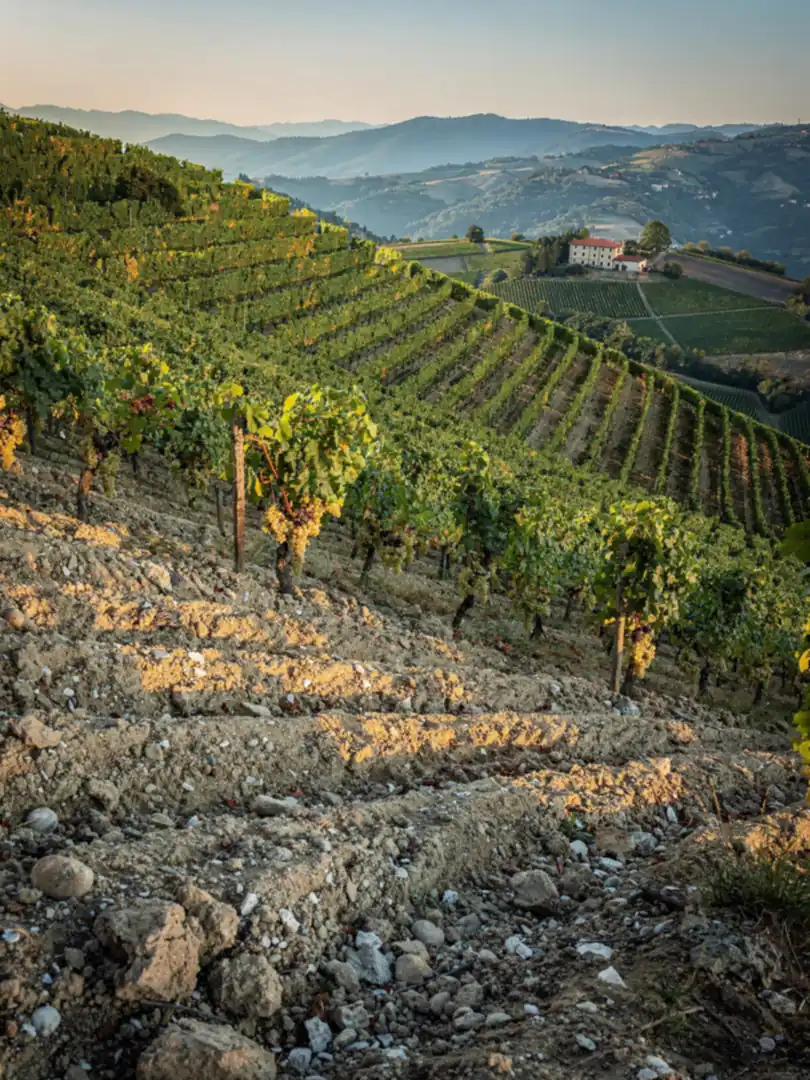
Marine Marl, Tuff Cellars
Soil & Climate
Where vines grow today, there was once a seabed millions of years ago. It left behind clay-rich marl with sand and limestone, and it is on this ground that the Moscato vines of Asti grow. The climate is continental, with cold winters, hot summers, and autumn fog.
The hills around Canelli and Santo Stefano Belbo are steep in many places, and the best sites face south. There it gets warm enough in summer for the berries to accumulate plenty of sugar, while cool nights preserve the aroma. After the late-summer harvest, there's little time to spare, since the sweet must spoils quickly if not kept cool.
Acidity plays a minor role in Asti. Moscato brings relatively little of it, so freshness comes instead from the carbonation and from the cold at which the must is stored. That's why Asti tastes best well chilled and is never served warm.
Beneath Canelli lies a second, hidden world. Between the 16th and 19th centuries, galleries and vaults were carved into the soft limestone tuff of the hills. They reach depths of up to 32 meters, span roughly 20 kilometers in total, and maintain a temperature of 12 to 14 degrees Celsius year-round. They are known as the Cattedrali sotterranee, the underground cathedrals.
They were designed to keep sparkling wine cool, long before refrigeration existed. The best-known cellars belong to the houses of Bosca, Contratto, Coppo, and Gancia. In 2014, UNESCO added the wine landscape of Langhe-Roero and Monferrato to its World Heritage list, and the zone of Canelli and Asti Spumante with these cellars is one of its components.