Beyond the Po
Region & History
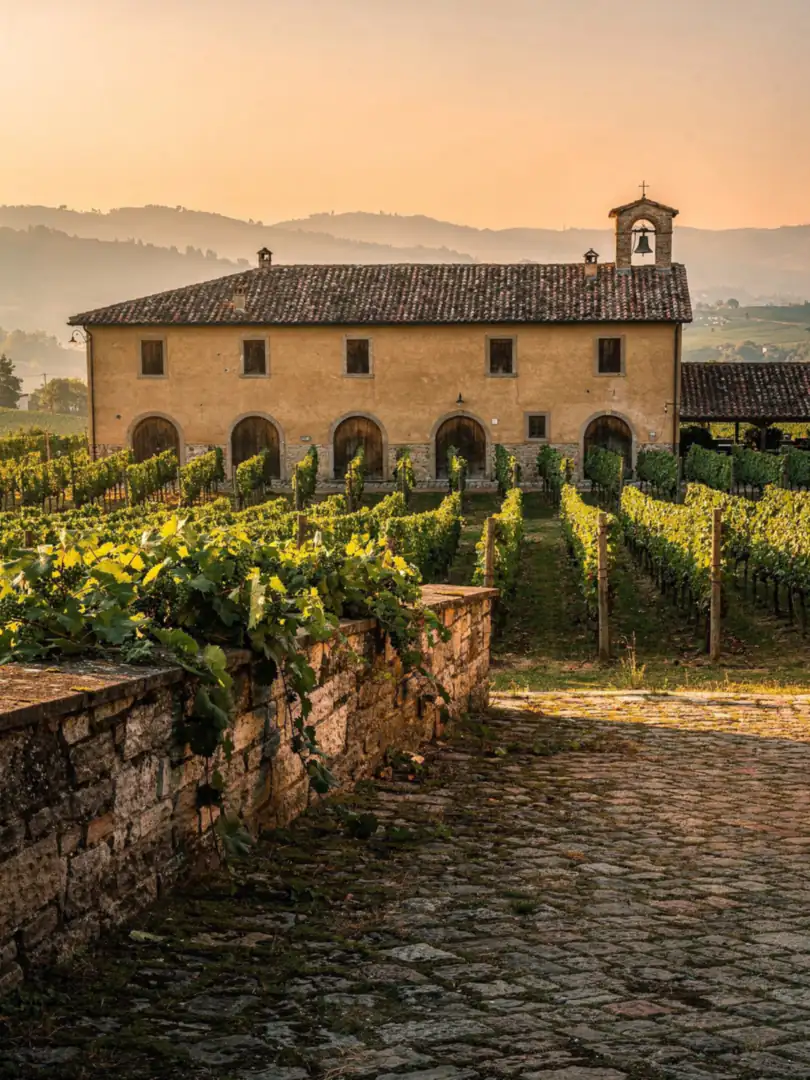
Oltrepò Pavese Metodo Classico is the name given to the sparkling wine from the hills south of the Po in the Province of Pavia, Lombardy. The name says it all: Oltrepò means "beyond the Po," seen from Pavia. Anyone crossing the river from the plain finds gentle hills rising toward the Apennines.
The story of this sparkling wine begins here around 1865. Count Augusto Giorgi di Vistarino is said to have brought Pinot Nero cuttings from France and planted them on his estate at Rocca de' Giorgi. That's how the tale is still told in the region today, and the grape variety has grown here for a good 150 years.
The growing area stretches from the hills around Casteggio and Broni up into the higher valleys of Versa, Scuropasso, and Staffora. Towns like Santa Maria della Versa and Montecalvo Versiggia sit right in the heart of sparkling wine country.
Metodo Classico received its own legal framework with the DOCG, generally dated to 2007. It requires at least 70 percent Pinot Nero, with the remainder made up of Chardonnay, Pinot Grigio, and Pinot Bianco. If "Pinot Nero" appears as an additional designation on the label, the wine must contain at least 85 percent of the variety. The protected wine is identified by the designation "Oltrepò Pavese Metodo Classico."
The rosé counterpart has its own name: Cruasé, a coined word blending "cru" and "rosé." It's a collective trademark of the consortium, used by members for rosé sparkling wine made from 100 percent Pinot Nero; it was introduced in 2009 at the Vinitaly trade fair.
Around 3,000 hectares of Pinot Nero grow in the Oltrepò, out of roughly 13,500 hectares of vineyard in total. That makes the area Italy's largest Pinot Nero growing region. The fact that so much Pinot Nero grows so close to Milan surprises many people who first think of Prosecco when it comes to Italian sparkling wine.