Capital of Cava
Region & History
If you want to know where Cava comes from, head to Sant Sadurní d'Anoia, a small town in the Alt Penedès west of Barcelona. Codorníu and Freixenet, two of the best-known names in Cava, are headquartered here, and the town calls itself the capital of Cava.
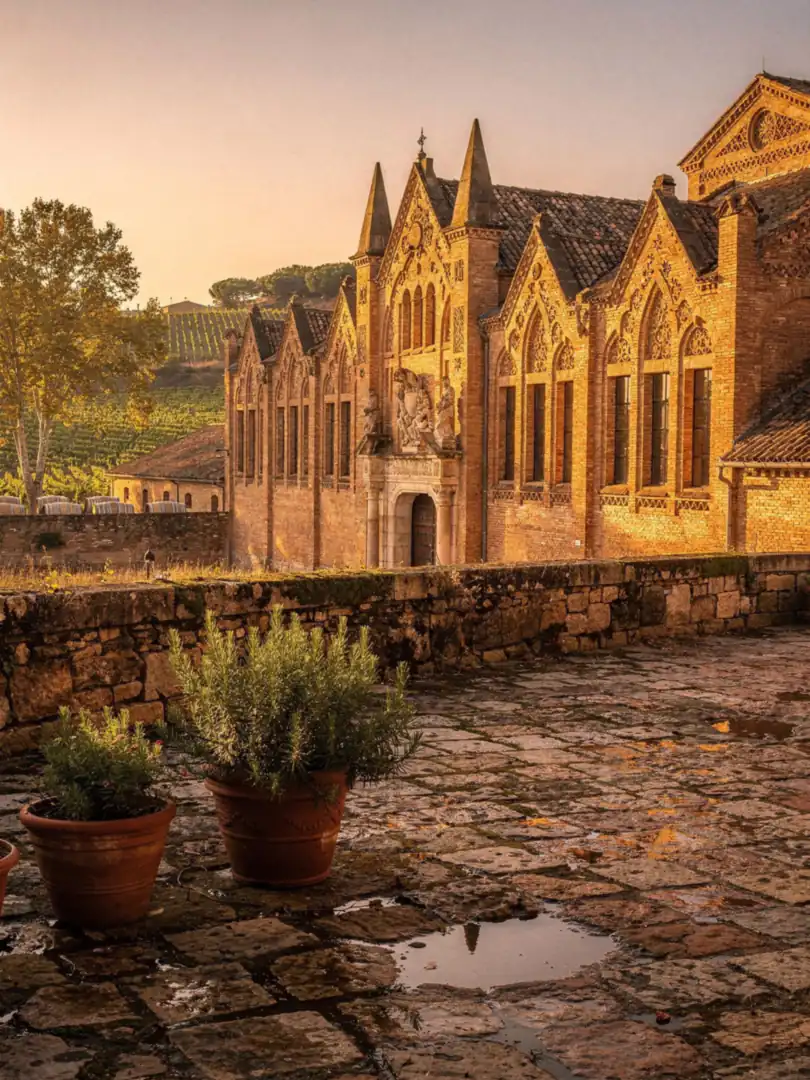
The Raventós family made their first sparkling wine here in 1872—the full founding story is told in the wine journey through the Penedès. For this journey, what matters is what came next: Manuel Raventós had the cellar complex built between 1895 and 1915, designed by Josep Puig i Cadafalch. The architect belongs to the Catalan Modernisme movement, and the complex has been protected as a monument of national importance since 1976. Thanks to their soaring vaults, the halls are often compared to cathedrals.
Freixenet grew out of the Casa Sala winery, founded by Francesc Sala Ferrés in 1861. In 1914, the Ferrer and Sala families bottled the first bottle of Cava Freixenet. Since 2018 the German sparkling wine producer Henkell held the majority stake, and since March 2026 the house belongs to it entirely.
The protected designation of origin is younger than the houses themselves. The Cava region was defined by ministerial decree on February 27, 1986, and the regulations followed on November 14, 1991, permitting only traditional bottle fermentation. In 2025, the D.O. counted 191 Cava producers and 5,957 grape-growing estates.
Sant Sadurní lies in the Comtats de Barcelona zone, which accounts for more than 95 percent of all Cava bottles produced. For the country as a whole, the D.O. reported around 190 million bottles for 2025, about 60 percent of which went to export.
Every year in early October, the Cavatast fair showcases Cava and regional cuisine over three days, with around fifty producers taking part. Codorníu and Freixenet are the face of Cava for most people, but smaller family houses with their own cellars also work here.