Levels and Sugar
Lees Aging & Dosage
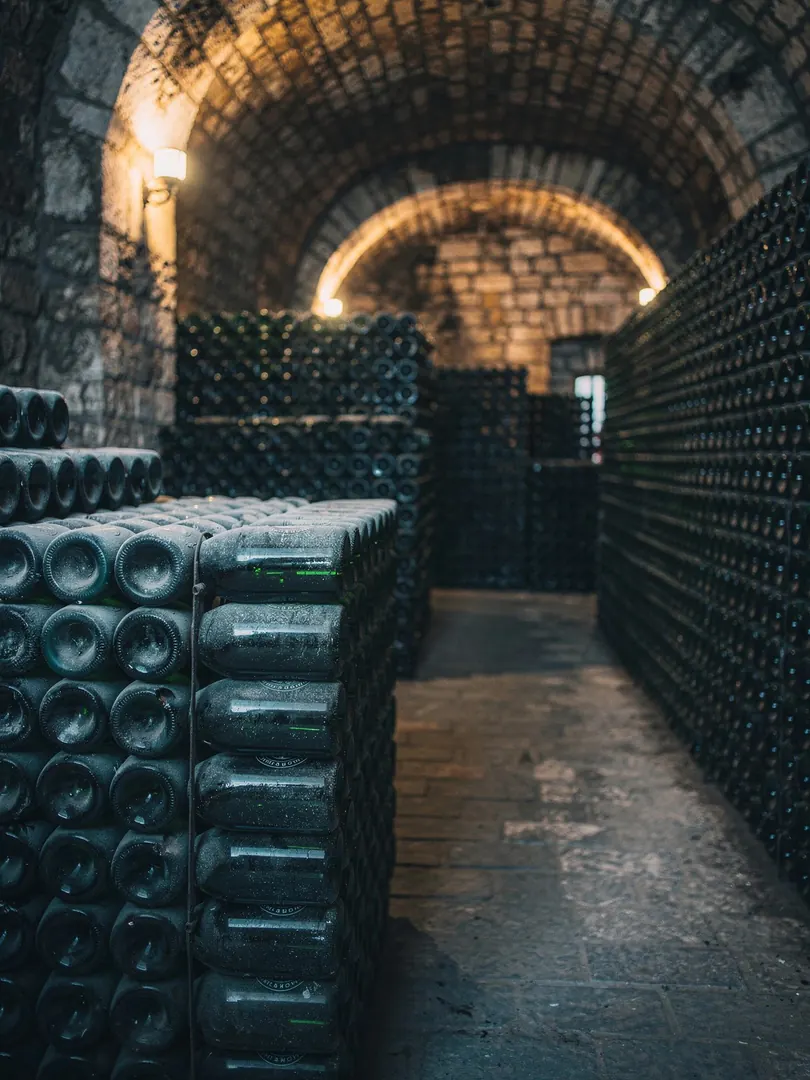
How long a Cava must rest on the lees depends on its tier. Since the 2020 reform, which applies to bottles from January 1, 2022 onward, a Cava de Guarda requires at least nine months. The Guarda Superior tier starts at 18 months as Reserva, rises to 30 months as Gran Reserva, and reaches a minimum of 36 months as Cava de Paraje Calificado.
During this time, the flavor takes shape. The dead yeast cells slowly break down, releasing proteins and amino acids into the wine. This is called autolysis. It's responsible for notes of brioche, almond, and nut, as well as a creamier mousse.
To release the yeast later, the bottles are riddled. This used to be done by hand on riddling racks; today, machines usually handle the work, until the yeast has collected in the neck of the bottle.
Disgorgement follows. The neck of the bottle is chilled so the yeast freezes into a plug, the crown cap is released, and the pressure shoots the plug out. Whatever wine is lost in the process is replaced by the cellar master with the dosage liqueur, a mixture of wine and sugar.
The dosage determines the sweetness level, and here it pays to check the label carefully, since the terms can be misleading. Under 3 grams of sugar per liter, the wine is called Brut Nature; up to 6 grams, Extra Brut; under 12 grams, Brut. Extra Seco, at 12 to 17 grams, is noticeably sweeter, and Seco, at 17 to 32, even more so—despite Seco meaning dry. Semi Seco falls between 32 and 50, Dulce above 50.
A Cava Gran Reserva or Paraje may only be sold as Brut Nature, Extra Brut, or Brut. Sugar would tend to mask the yeast notes developed during such long aging. In Sant Sadurní, this waiting period is simply part of everyday life in the cellars of Codorníu and Freixenet.