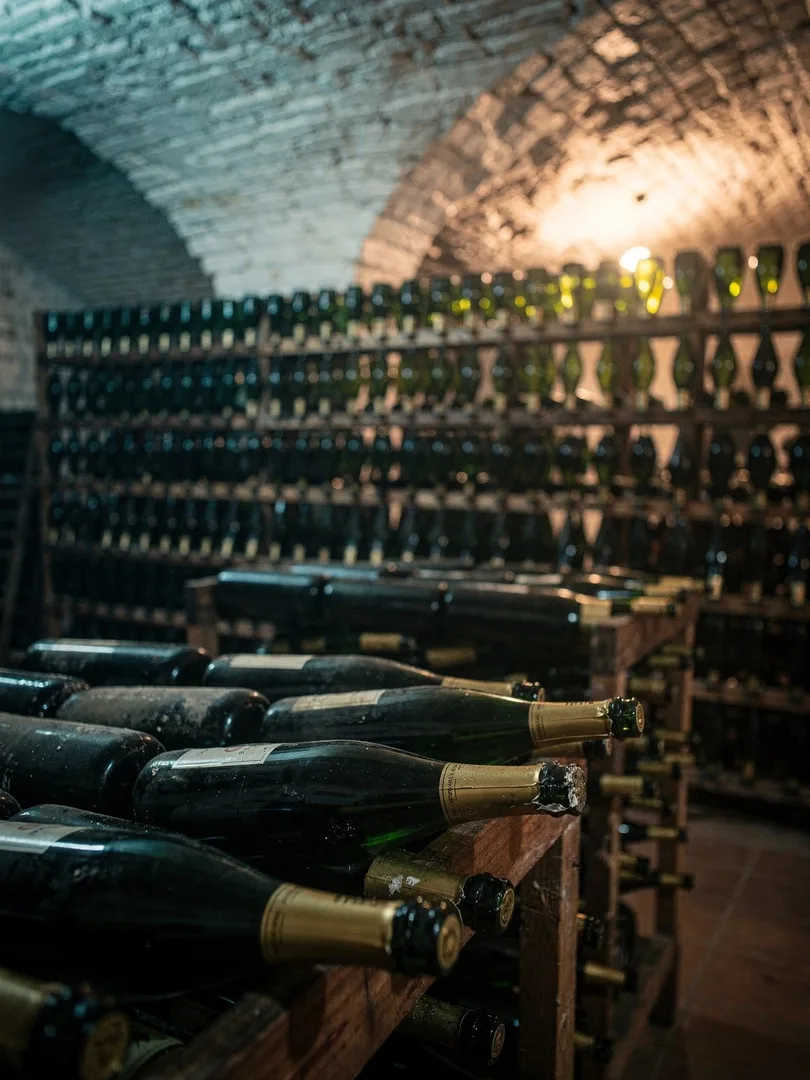
Twelve Months on the Lees
Lees Aging & Dosage
Twelve months has been the minimum since the 2019 vintage: that's how long a Cap Classique must rest on the lees at the very least, up from nine previously. The Cap Classique Producers Association sets only this floor; how much longer a wine ages beyond that is up to each individual house.
It's on the lees that the transformation happens that sets sparkling wine apart from a simple pétillant wine. The spent yeast cells break down, a process experts call autolysis, releasing proteins and aromatic compounds into the wine. This produces notes of brioche, biscuit and nut, and over time the mousse grows finer and the foam creamier.
Houses often leave their top cuvées to rest well beyond the minimum, sometimes for several years. The longer the yeast works, the less the wine tastes of pure fruit and the more it takes on notes of pastry and spice.
By the end, the yeast sits as sediment in the bottle. To remove it, the bottles are placed neck-down and gradually turned and shaken over several weeks, either by hand on a riddling rack or by a mechanical riddler (gyropalette). The sediment slowly slides down into the neck of the bottle.
Next comes disgorgement. The neck of the bottle is deeply chilled, and when it's opened, the frozen plug of sediment is forced out by the pressure. The lost volume is topped up with the dosage, a mixture of wine and sugar, which determines just how sweet the finished sparkling wine will taste.
The European scale serves as a guide: Brut Nature under 3 g/l sugar, Extra Brut up to 6, Brut under 12, and Extra Dry between 12 and 17 g/l, meaning sweeter than Brut. Graham Beck offers Brut Zero, a line whose name promises no added dosage, alongside the sweet Bliss Demi Sec.