Citrus and Brioche
Tasting
What does a Cap Classique taste like? Mostly citrus, green apple and brioche, with a taut acidity that keeps the palate fresh. The longer the wine spent on the lees, the more pastry and nut notes come to the fore. A Blanc de Blancs tends to feel leaner, while a Pinot Noir-driven wine shows more fullness.
Simonsig's Kaapse Vonkel shows how a style from the Stellenbosch slopes can taste: a Brut, built since 1987 from Pinot Noir and Chardonnay, and thus conceived close to the Champagne model.
Graham Beck offers a good opportunity to compare levels. The Brut from the non-vintage range sets the house style, the Blanc de Blancs shows pure Chardonnay with real tension, and the Brut Zero is the most austere, since it lacks the sugar that would otherwise soften its acidity. The Cuvée Clive sits at the top of the range.
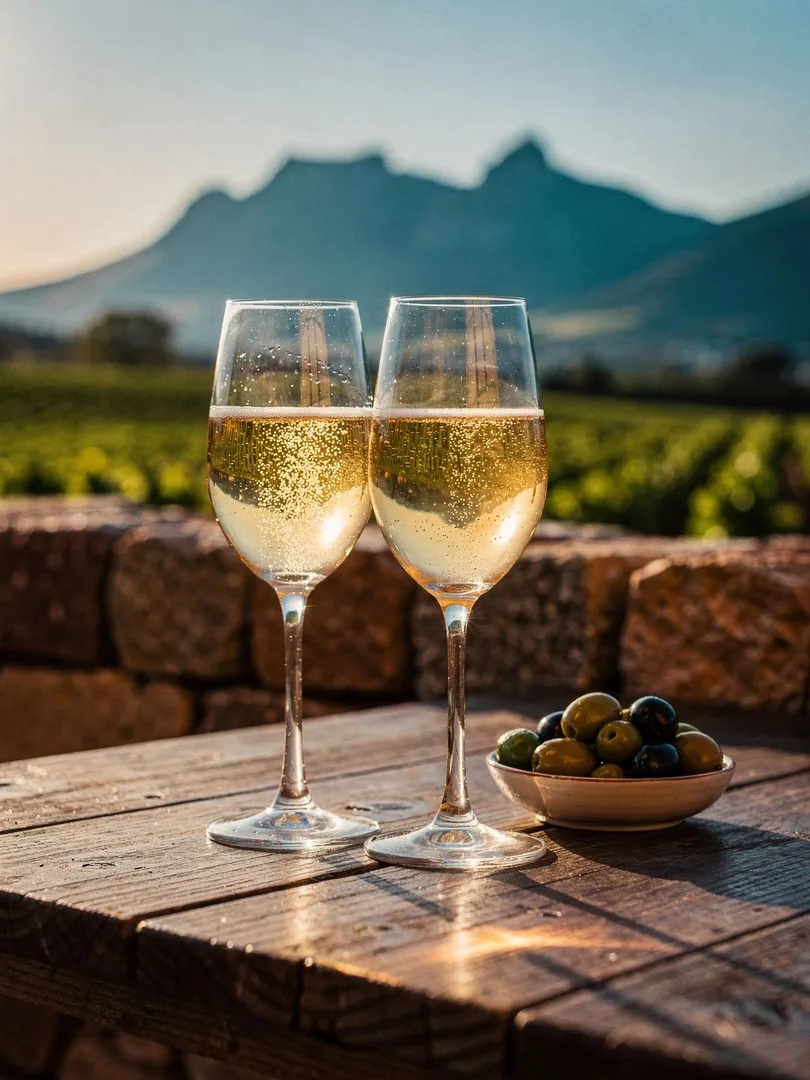
A tulip glass is better than a flat coupe. It's wide at the base and narrower at the top, so the aromas can gather, and the bubbles rise in a long, steady stream. The coupe lets aroma and carbonation escape too quickly.
Serve cool, not cold, at around six to eight degrees Celsius. Too cold and the aromas close up. Half an hour in the fridge is enough, after which the bottle can sit briefly at room temperature before pouring.
To open, remove the foil, loosen the wire cage, and keep a hand firmly on the cork. Turn the bottle rather than the cork, holding it at an angle, until you hear a quiet hiss. A loud pop means lost carbonation and foam all over the table.