Liqueur d'expédition
Dosage in Champagne: what is the liqueur d'expédition?
The dosage in Champagne is a small amount of sugar, dissolved in wine, added to the bottle after disgorgement. Experts call it the shipping dosage or liqueur d'expédition. It determines whether a Champagne goes to market as Brut, Extra Dry, or Demi-Sec.
What's in the liqueur d'expédition?
EU law describes the liqueur d'expédition matter-of-factly as a product added to sparkling wine to achieve a particular taste. Permitted ingredients include sucrose—ordinary beet or cane sugar—as well as grape must, concentrated or rectified grape must, partially fermented must, and wine. Rectified means purified: a color- and flavor-neutral grape concentrate. Wine distillate is also allowed. This is governed by Delegated Regulation (EU) 2019/934, Annex II.
One limit concerns alcohol. The liqueur d'expédition may raise the existing alcohol content by at most 0.5% by volume. In practice, many cellars dissolve sugar in wine, often in their own house's reserve wine. Some give their dosage a distinctive character using an aged wine or a touch of distillate. Many houses treat the exact recipe as a trade secret.
The term dosage can be confusing because it refers to two different things. In everyday use, it means the liqueur d'expédition added at the end. Technically, there's also the liqueur de tirage at the start, which triggers the second fermentation. Only the liqueur d'expédition remains in the wine as sweetness; the liqueur de tirage is fermented into carbon dioxide and alcohol. Station 6 explains the difference in more detail.
When does the dosage go into the bottle?
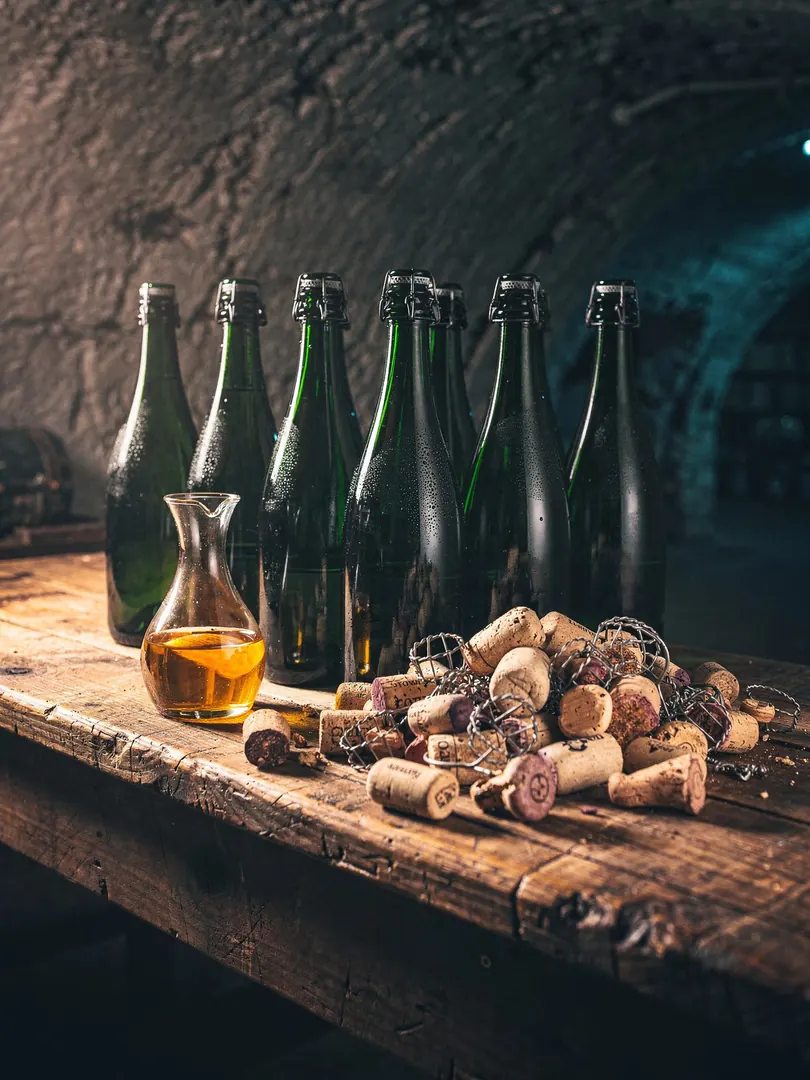
With traditional bottle fermentation, the dosage is added right at the end. After lees aging, the yeast sediment is collected in the neck of the bottle through riddling, the neck is frozen in a cold brine solution, and the crown cap is removed. The pressure shoots out the frozen plug of yeast sediment. This causes a small loss of wine. The cellar fills this gap with the liqueur d'expédition, then the cork and wire cage (the muselet, the wire basket over the cork) follow.
How much wine is lost during disgorgement varies from bottle to bottle. Modern equipment compensates for this and brings every bottle to the same fill level. The amount of dosage is calculated so that the desired sugar level is reached across the entire bottle contents—the wine plus the topped-up portion together.
With tank fermentation, as is common for many Prosecco and branded sparkling wines, sweetness is adjusted in the tank before bottling. The wine is filtered after the second fermentation and bottled under counter-pressure. A separate disgorgement step is skipped, but the effect on flavor is the same. Here too, the dosage determines the category stated on the label.
How the cellar master determines the dosage
Finding the right amount comes down to tasting trials. Many cellars run test series, for example the same cuvée with 0, 4, 7, and 10 grams of sugar, tasted side by side. The goal is the point where the acidity stays lively while the wine still feels harmonious. A cool vintage with high acidity usually calls for more sugar than a warm one.
Lees aging also plays a role. The longer a wine has rested on the lees, the more richness it brings with it, and the less dosage it often needs. Many houses let the wine rest for several weeks or months after disgorgement before releasing it for sale. During this time, the dosage and wine integrate. Some producers print the disgorgement date on the back label so connoisseurs can gauge the wine's age relative to the dosage.
At large houses, the dosage is part of the house style. Their Brut should taste recognizable year after year, even when the grapes ripened to different degrees. The dosage is one of several tools used to achieve this, alongside reserve wines from older vintages and the selection of vineyard sites.
Dosage in numbers: amount and the 3 g/l tolerance
A calculation example illustrates the scale. If a Champagne with no significant residual sugar is to end up with 8 grams of sugar per liter, the 0.75-liter bottle needs 6 grams. If the sugar solution is prepared at 500 grams per liter, that's 12 milliliters. These are small quantities that must be measured precisely. In large cellars, dosing machines handle this.
During inspection, the measured sugar content may deviate from the figure on the label by at most 3 grams per liter, per Article 47(3) of Regulation 2019/33. This tolerance allows room for measurement variation and differences from bottle to bottle. It doesn't change the conditions of individual categories, though. For Brut Nature, added sugar after the second fermentation remains prohibited, no matter how small the amount.