Long on the Lees
Lees Aging & Dosage
How long must sparkling wine from Oregon rest on the lees? No region of origin mandates it; each house decides for itself. For comparison: in the EU, the traditional bottle fermentation method requires at least nine months on the lees. Non-vintage Champagne needs twelve months on the lees and fifteen before sale, while vintage Champagne requires thirty-six.
During this time, the yeast cells slowly break down, a process called autolysis. They release proteins and flavor compounds into the wine, making it creamier and adding notes of brioche and toasted nuts. The longer this takes, the finer the bead often becomes.
The houses of the valley take their time. According to the winery, Soter's Mineral Springs Brut Rosé 2019 spent 42 months on the lees—more than three and a half years. Argyle released an Extended Tirage from 2007 that wasn't disgorged until July 2017, nearly a decade after harvest.
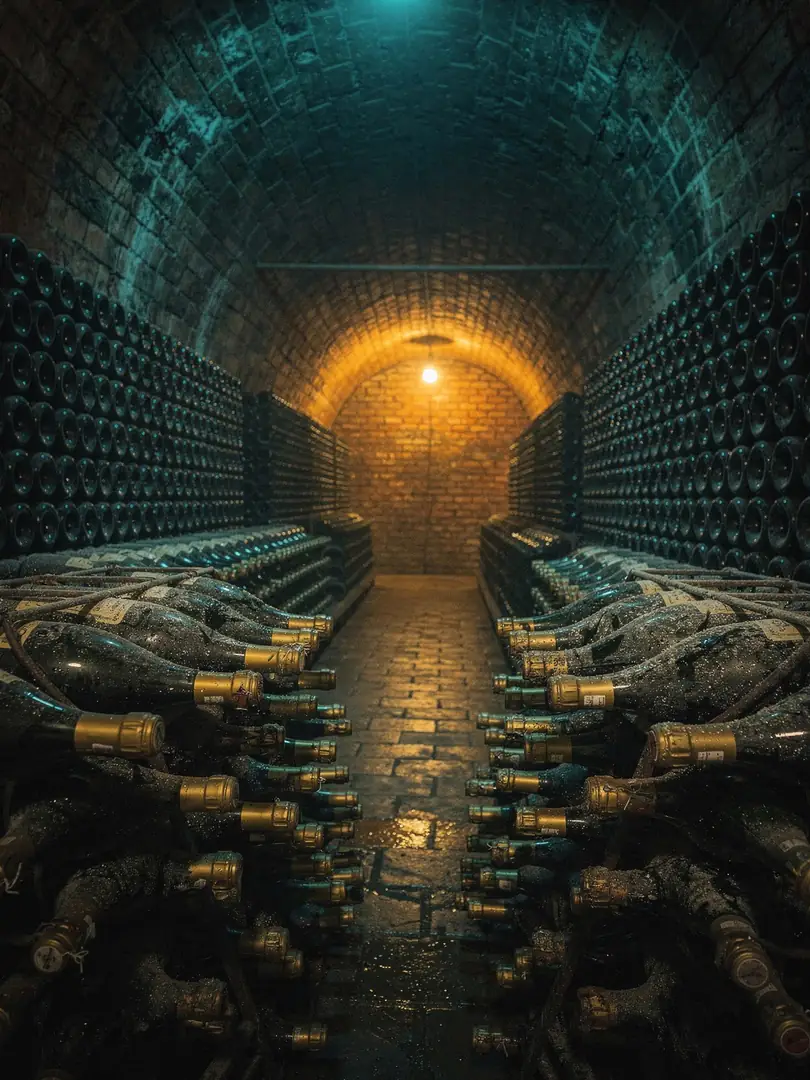
In the end, the yeast must come out. The bottles are stored upside down, the sediment settles in the neck, the neck is chilled, and upon opening, the pressure pushes the plug of yeast out. This is called disgorgement.
The resulting gap is filled by the dosage, a mixture of wine and sugar that determines the sweetness. According to the winery, Soter added 4 grams per liter to its 2019 rosé and labels it Brut. By the European scale, that would already fall into Extra Brut territory, at 0 to 6 g/l; Brut goes up to just under 12 g/l, and Extra Dry, at 12 to 17 g/l, is even sweeter.